
See the auroral oval expand as geomagnetic activity (teaching Kp) rises, and match curtain colours to emission altitudes - green oxygen 557.7 nm (~90-150 km), red oxygen 630.0 nm (~200-300 km), and blue/purple N2+ 427.8 nm at the lower fringe.
Quiet-time ovals sit near ~65-70 deg magnetic latitude (NOAA SWPC OVATION literacy). Higher teaching Kp pushes the glowing band toward lower latitudes - a storm expansion cue, not a live forecast feed.
Distinct from Earth 3D Globe: that page teaches geography and lighting; this page isolates aurora altitude colours and oval expansion.
Aurora 3D Explorer
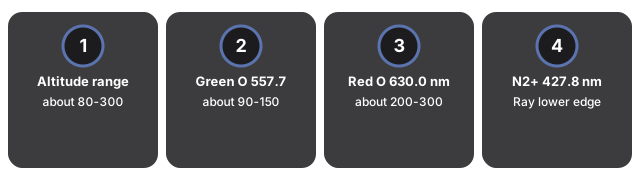
Aurora 3D Explorer shows the auroral oval expand as teaching Kp rises from 0 to 9, and matches curtain colours to emission altitudes - green oxygen 557.7 nm (about 90-150 km), red oxygen 630.0 nm (about 200-300 km), and blue/purple N2+ 427.8 nm at the lower fringe.
Drag to orbit the night-side Earth, step the Kp - / Kp + slider, and pause spin when you want a still curtain against the facts panel. Reset returns the demo to teaching Kp 3 so a quiet oval sits near 65-70 deg magnetic latitude before you storm-expand it.
The facts panel cites the same altitude bands and quiet oval latitudes used in NOAA SWPC OVATION literacy so the colour-vs-height takeaway stays reliable - geometry is compressed for readability.
- Altitude envelope about 80-300 km
- Green O 557.7 nm peak about 90-150 km
- Red O 630.0 nm peak about 200-300 km
- Quiet oval about 65-70 deg magnetic latitude; expands equatorward as Kp rises
- Kp teaching slider 0-9 with reset to Kp 3
- Runs fully in the browser with the vendored three.js engine - no account, no upload
Teachers use Aurora 3D Explorer for storm-expansion and emission-line demos, students connect Kp to oval width, and curious readers separate green/red/purple bands without a planetarium install.
| Quantity | Value | Source |
|---|---|---|
| Altitude range | about 80-300 km | Standard aurora emission-altitude literature |
| Green O 557.7 nm | about 90-150 km | Oxygen (1D) green-line peak |
| Red O 630.0 nm | about 200-300 km | Oxygen red-line; needs strong precipitation |
| N2+ 427.8 nm | Ray lower edge | Molecular nitrogen ion blue/purple |
| Quiet oval | about 65-70 deg mag lat | NOAA SWPC OVATION literacy |
Everything renders on your device with WebGL. The 3D engine loads once (about 0.7 MB) and is cached; no scene data is sent to a server.
Aurora 3D Explorer is an educational oval and emission-altitude visualization - it is not a live NOAA SWPC forecast or real-time magnetometer feed, not a particle-precipitation solver, and not an observing-site trip planner. For geography and day/night lighting without curtains, use Earth 3D Globe.
For a step-by-step walkthrough, read the Aurora 3D Explorer step-by-step guide. The Space 3D collection also includes Seasons Earth 3D Explorer.
Frequently Asked Questions
What does Aurora 3D Explorer show?
An Earth-centered auroral oval with teaching Kp expansion and colour bands tied to green 557.7 nm, red 630.0 nm, and N2+ 427.8 nm altitudes.
Is this a live aurora forecast?
No. Kp here is a classroom slider. For forecasts, use NOAA SWPC products - this page only teaches oval expansion and colour-vs-height literacy.
Why is green more common than red?
Green oxygen 557.7 nm peaks around 90-150 km where denser air makes the green line bright. Red 630.0 nm needs higher, thinner altitudes (~200-300 km) and stronger particle precipitation.
Is this the same as Earth 3D Globe?
No. Earth 3D Globe focuses on geography and lighting. This page isolates auroral ovals, Kp expansion, and emission altitudes.
Are altitudes and latitudes to scale?
Heights and globe size are compressed for readability. The published altitude bands and quiet-oval latitudes in the facts panel stay the reliable takeaway.
Does any data leave my device?
No uploads and no login. The vendored three.js engine renders on your device; status and facts stay in the browser.