
Miranda is only about 470 kilometers across, yet Voyager 2 found Verona Rupes - a scarp often cited among the tallest cliffs in the Solar System, with published height estimates spanning roughly 5 to 20 kilometers. Press play to orbit the icy moon, face the cliff, and watch a slow free-fall marker that shows how long a drop would take in Miranda's weak gravity.
Published figures: Miranda mean diameter ~470 km; Verona Rupes height estimates ~5-20 km (Voyager 2 geometry limited); free-fall popular estimate ~10-12 minutes to ~200 km/h (NASA APOD / secondary summaries); imaged Voyager 2 January 1986; IAU name 1988.
Drag to orbit and scroll or pinch to zoom. Press Play or toggle Fall.
Miranda Verona Rupes 3D Explorer
Miranda is the innermost of Uranus's five major moons - mean diameter about 470 kilometers - and one of the most topographically extreme small worlds known. During Voyager 2's January 1986 flyby, the spacecraft imaged Verona Rupes, a giant fault scarp named for Shakespeare's Verona and approved by the IAU in 1988. Published height estimates for the cliff commonly span about 5 to 10 kilometers, with other summaries citing values up to roughly 20 kilometers; the spread reflects Voyager's limited viewing geometry and resolution, so this page keeps the range rather than inventing a single figure.
Miranda's surface gravity is tiny compared with Earth. Popular NASA APOD and secondary summaries note that a free-fall from the top could take on the order of 10 to 12 minutes and reach about 200 kilometers per hour at the bottom - a thought experiment that makes the cliff's scale feel real. This explorer shows the icy moon, a schematic Verona Rupes face, and an optional slow-fall marker. It is not a dynamics solver.
- Miranda with a schematic Verona Rupes cliff face
- Optional free-fall marker along the scarp
- Height-range disclosure instead of a fake single number
- Speed slider and Play/Pause rotation
- Runs fully in the browser with the vendored three.js engine - no account, no upload
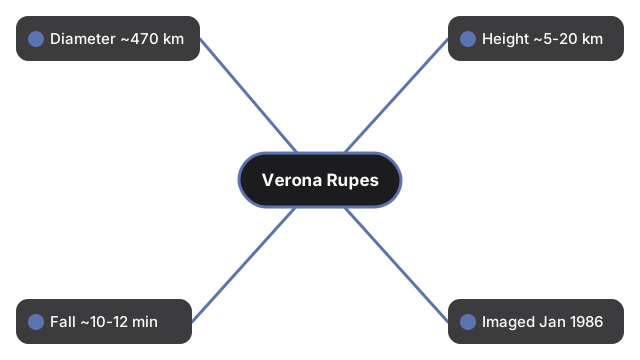
Anyone comparing cliffs across the Solar System gets a concrete sense of how a small icy moon can host a scarp taller than any Earth mountain wall.
| Figure | Value | Source note |
|---|---|---|
| Miranda mean diameter | ~470 km | Britannica / NASA Uranian moons |
| Verona Rupes height | ~5-20 km (range) | Voyager 2 era estimates; often ~5-10 km |
| Free-fall time / speed | ~10-12 min / ~200 km/h | Popular NASA APOD-linked estimate |
| Discovery imaging | January 1986 | Voyager 2 |
| IAU name | 1988 | Verona (Shakespeare) |
| Orbital period | ~1.413 days | Around Uranus |
Everything renders on your device with WebGL. The 3D engine loads once (about 0.7 MB) and is cached; no scene data is sent to a server.
This is an educational visualization - Miranda is a smooth sphere, the cliff is a schematic face with exaggerated relief for readability, and the fall marker is illustrative, not a gravity integrator.
For a step-by-step walkthrough, read the Miranda Verona Rupes 3D Explorer step-by-step guide. The Space 3D collection also includes Vesta Rheasilvia Basin 3D Explorer and Phobos Stickney Crater 3D Explorer for related giant-feature context on small bodies.
Frequently Asked Questions
How tall is Verona Rupes?
Published estimates commonly span about 5 to 20 kilometers. Many technical summaries favor roughly 5 to 10 kilometers; some popular accounts cite about 20 kilometers. Voyager 2's viewing geometry limits precision, so this page shows the range.
Is it the tallest cliff in the Solar System?
It is often cited as a leading candidate for the tallest known cliff, but the height uncertainty means the claim is provisional.
How long would a fall take?
Popular estimates based on Miranda's low gravity put a free-fall near 10 to 12 minutes, reaching about 200 kilometers per hour - a thought experiment, not a measured event.
When was it imaged?
Voyager 2 imaged Verona Rupes during the Uranus encounter in January 1986; the IAU approved the name in 1988.
Is the cliff face exact?
No. The scene uses a schematic scarp so the height range stays readable; Voyager topography is far more irregular.
Does this model Uranus itself?
No. The explorer focuses on Miranda and Verona Rupes only.
Is this a physics simulation?
No. It is an educational visualization with an illustrative fall marker, not a gravity integrator.