
In October 2017, astronomers found something that had never been confirmed before: an object from outside our Solar System, just passing through. 'Oumuamua came in on a path that never closes, tumbled end over end rather than spinning cleanly, and showed no visible gas or dust at all - yet its actual path bent very slightly more than gravity alone could explain. Watch it swing past the Sun below, then toggle the leading (unconfirmed) explanation for that bend.
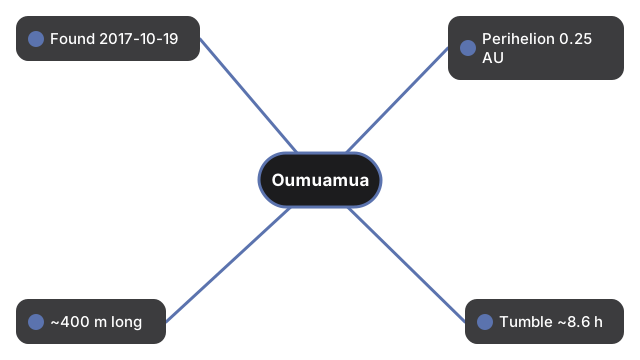
Published figures: discovered 19 October 2017; closest approach to the Sun on 9 September 2017 at about 0.25 AU and 87.3 km/s; about 400 m long and roughly 10 times longer than wide; a real, statistically significant (30-sigma) bend in its path beyond what gravity alone explains.
Drag to orbit and scroll or pinch to zoom. Press Play, change the speed, or toggle Outgassing.
'Oumuamua 3D Explorer
On 19 October 2017, Canadian astronomer Robert Weryk spotted something moving through the Pan-STARRS telescope's field of view in Hawaii that did not belong. Its path was hyperbolic - not a closed ellipse like every planet, comet, and asteroid in our Solar System - meaning it was never bound to the Sun at all.
How 'Oumuamua got its name and its record
It had arrived from interstellar space, swung around the Sun on 9 September 2017 at a blistering 87.3 kilometers per second, and was already leaving, never to return. It was named 'Oumuamua, Hawaiian for a scout or messenger sent from the distant past, and it remains the first confirmed interstellar object ever detected.
The shape and tumble that made it strange
Everything about it was strange. It was extraordinarily elongated - roughly ten times longer than it is wide, about 400 meters end to end - and instead of spinning cleanly on one axis, it tumbled, its brightness swinging by a factor of about 15 as its long axis rotated in and out of view. It showed no coma, no dust, nothing a normal comet would show near the Sun.
The 30-sigma path anomaly and the leading explanation
And yet, when astronomers tracked its exact path with extreme precision, they found it was bending very slightly more than gravity alone could explain - a real, statistically significant deviation, detected at 30-sigma confidence. That combination - comet-like physics with a completely inert, asteroid-like appearance - has never been fully resolved. The leading explanation is outgassing of some invisible gas, similar to how a comet's own escaping gas can nudge its path, but the paper that first measured the effect was careful to call this "a physically viable explanation," not a proven one. A small minority of scientists floated the idea of artificial technology; mainstream astronomy does not support it, and it is not the leading explanation.
What the 'Oumuamua explorer lets you change
- The object rendered at its real, highly elongated ~10:1 proportions
- A tumbling, non-principal-axis rotation with the real ~15x brightness swing
- Its actual hyperbolic, never-repeating trajectory past the Sun
- An Outgassing toggle showing the leading (still unconfirmed) explanation
- Runs fully in the browser with the vendored three.js engine - no account, no upload
Who this page is for
Anyone who has heard "interstellar object" or "alien probe" headlines gets the real, precise numbers behind them; students see exactly what a hyperbolic, unbound trajectory looks like compared to every closed orbit shown elsewhere on this site.
Real 'Oumuamua figures at a glance
| Figure | Value | Source note |
|---|---|---|
| Discovered | 19 October 2017 | Pan-STARRS, Hawaii |
| Closest approach to Sun | 9 Sept 2017, about 0.25 AU | 87.3 km/s at closest approach |
| Size | about 400 m long, roughly 10x longer than wide | Highly elongated, reddish |
| Rotation | tumbling, about 8.6-hour period | Non-principal-axis, not simple spin |
| Trajectory anomaly | detected at 30-sigma significance | Beyond pure gravity |
| Leading explanation | invisible outgassing | Still not fully confirmed |
How this page differs from the other interstellar-object explorers
For a step-by-step walkthrough, read the 'Oumuamua 3D Explorer step-by-step guide. The Space 3D collection also includes Tabby's Star 3D Explorer, another real case where media coverage of an exotic hypothesis outran the actual science.
Limits of this educational approximation
This is an educational visualization, not a trajectory simulation - the object, Sun, and path are all scaled for legibility, and the flyby is looped for this demo; the real event happened once and will never repeat. The tumble rate and brightness swing are heavily sped up. Everything renders on your device with WebGL. The 3D engine loads once (about 0.7 MB) and is cached; no scene data is sent to a server.
Frequently Asked Questions
What is 'Oumuamua?
The first confirmed object from outside our Solar System ever detected, discovered in October 2017 on a hyperbolic path that will never repeat.
How do we know it came from another star system?
Its trajectory is hyperbolic and unbound to the Sun - it was never in a closed orbit, so it must have arrived from, and is now returning to, interstellar space.
Is it really an alien probe?
Mainstream astronomy does not support this. A small minority of scientists raised the idea; the leading explanation is invisible outgassing, though the case is not fully closed.
What makes its trajectory anomalous?
Its path bent very slightly more than gravity alone predicts, at a statistically significant 30-sigma level - a signature normally seen in comets, even though it showed no visible comet activity.
How big and what shape is it?
About 400 meters long and roughly ten times longer than it is wide - far more elongated than any asteroid or comet seen in our own Solar System.
Why does its brightness change so much?
It tumbles rather than spinning cleanly, so its long axis rotates in and out of view, swinging its brightness by a factor of about 15.
Is this scene to scale?
No. The object, Sun, and path are scaled for legibility, and the flyby loops for this demo - the real event happened once and will never repeat.