
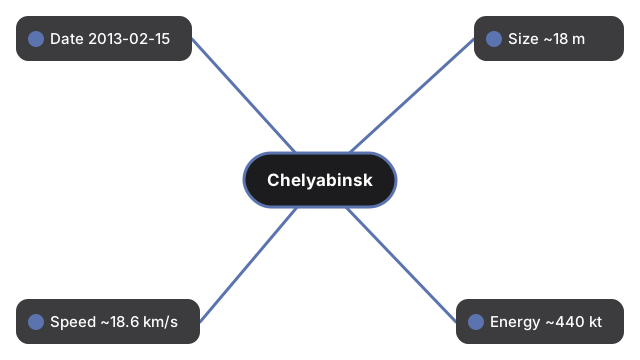
On 15 February 2013, a roughly 18-meter asteroid entered Earth's atmosphere over Chelyabinsk, Russia on a shallow path at about 18.6 km/s. It brightened for more than 16 seconds, peaked near 23 km altitude, and released about 440 kilotons of energy - the most powerful atmospheric impact observed since Tunguska. Press play to watch the shallow entry brighten into an airburst.
Published figures: ~17-20 m diameter, ~11,000 tons, ~18.6 km/s, ~18 deg elevation, peak brightness ~23.3 km, ~440 kt TNT, ~16.5 s bolide duration (NASA CNEOS / peer-reviewed airburst papers).
Drag to orbit and scroll or pinch to zoom. Press Play or change the speed to scrub the entry.
Chelyabinsk Meteor 3D Explorer
Just after dawn on 15 February 2013, a roughly 18-meter asteroid slammed into Earth's atmosphere over Chelyabinsk, Russia. It came in on a shallow path - about 18 degrees above the horizon - at roughly 18.6 kilometers per second. For more than 16 seconds it grew brighter and brighter, peaking near 23 kilometers altitude, then shattered in an airburst that released about 440 kilotons of energy. Windows shattered across the city; hundreds of people were hurt, mostly by flying glass. It remains the most powerful atmospheric impact observed since the 1908 Tunguska event.
This explorer walks through that real sequence: a shallow glowing trail, a rising brightness curve, and an airburst flash with an expanding blast shell. The same day, asteroid 2012 DA14 passed Earth safely more than 16 hours later - the two events were unrelated, and the scene does not mix them.
- A shallow entry path matching the real ~18-degree elevation
- A live brightness readout that peaks near the real airburst
- An expanding blast shell after peak brightness
- A speed slider and Play/Pause over a compressed entry timeline
- Runs fully in the browser with the vendored three.js engine - no account, no upload
Anyone who remembers the dashcam videos gets a clear sense of why a shallow, high-altitude burst can shatter windows far below without leaving a classic crater.
| Figure | Value | Source note |
|---|---|---|
| Date | 15 February 2013, 03:20:33 GMT | NASA CNEOS |
| Size / mass | ~17-20 m / ~11,000 tons | NASA estimate |
| Entry speed | ~18.6 km/s | At peak brightness |
| Entry angle | ~18 deg elevation | Shallow path |
| Peak altitude | ~23.3 km | NASA; later work ~29.7 km |
| Total energy | ~440 kt TNT | NASA impact energy |
Everything renders on your device with WebGL. The 3D engine loads once (about 0.7 MB) and is cached; no scene data is sent to a server.
This is an educational visualization, not a hydrocode airburst simulation - Earth, path, and blast sizes are enlarged for visibility, and the real multi-hundred-kilometer energy deposition is compressed into one illustrative burst.
For a step-by-step walkthrough, read the Chelyabinsk Meteor 3D Explorer step-by-step guide. The Space 3D collection also includes Meteor Shower Radiant 3D Explorer and Asteroid Belt 3D Explorer for related small-body contexts.
Frequently Asked Questions
What was the Chelyabinsk meteor?
A roughly 18-meter asteroid that entered Earth's atmosphere over Chelyabinsk, Russia on 15 February 2013 and exploded in a powerful airburst.
How energetic was it?
About 440 kilotons of TNT total impact energy - the strongest observed atmospheric impact since Tunguska in 1908.
Why was the path so shallow?
It entered at about 18 degrees above the horizon, so energy was spread along a long track high above the ground rather than as a steep, crater-forming strike.
Was it related to asteroid 2012 DA14?
No. 2012 DA14 passed Earth safely more than 16 hours later the same day; the two events were unrelated.
Why were people injured?
The blast wave shattered windows across the city; most injuries came from flying glass, not from meteorite impacts.
Is the altitude figure exact?
NASA's widely cited peak-brightness altitude is 23.3 km; later dashcam recalibrations place peak brightness near about 29.7 km. Both appear in the notes.
Is this scene to scale?
No. Earth, the meteor path, and the blast shell are enlarged and compressed for visibility, not a hydrocode simulation.