
A single planet orbiting a star should retrace the same ellipse forever. In reality the ellipse itself slowly rotates: its long axis swings around, the closest point (perihelion) creeps forward, and over many orbits the path fills in a beautiful rosette. For Mercury, a tiny part of that turn is the 43 arcseconds per century that only general relativity could explain. Slide the rate and watch the rosette form.
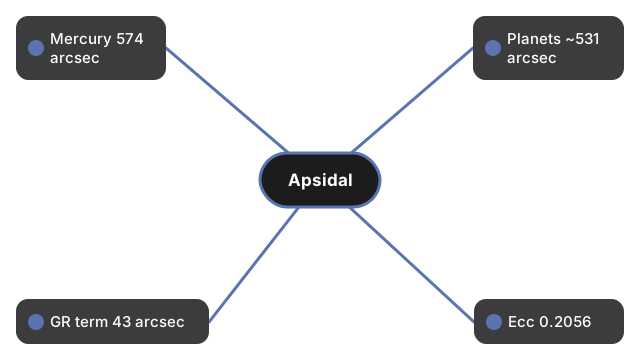
Published literacy: apsidal precession is the slow rotation of an orbit line of apsides (its long axis); Mercury perihelion advances 574 arcseconds per century, of which about 531 come from the pull of other planets and 43 from general relativity - the residual Einstein explained in 1915.
Drag to orbit and scroll or pinch to zoom. Slide the precession from zero (a closed ellipse) upward, hide the rosette trail, or pause the motion.
Apsidal Precession 3D Explorer
Isaac Newton showed that one planet orbiting one star traces a perfect ellipse that repeats forever. But no planet is truly alone. Tugs from the other planets - and, more subtly, the curvature of spacetime described by general relativity - make the ellipse itself slowly turn. Its long axis, the line of apsides, swings around; the closest point to the star, the perihelion, creeps forward each orbit; and the planet path gradually fills in a flower-like rosette. This explorer lets you dial that turning up and down and watch the rosette appear.
The most famous case is Mercury. Its perihelion advances by about 574 arcseconds every century. Most of that - roughly 531 arcseconds - is ordinary Newtonian gravity, the combined pull of Venus, Earth, Jupiter and the rest. But when astronomers subtracted all those effects, a stubborn 43 arcseconds per century was left over that Newton could not explain. Urbain Le Verrier flagged the discrepancy in 1859; some even proposed a hidden planet named Vulcan. The answer came in 1915, when Albert Einstein applied his new general theory of relativity and found it predicted an extra 43 arcseconds per century almost exactly. He called it one of his greatest joys. Apsidal precession also shows up wherever a central body is not a perfect point mass - a flattened, oblate star or planet nudges its satellites the same way.
- An elliptical orbit with the star at one focus, drawn live
- The line of apsides and the perihelion marker turning as the orbit precesses
- A rosette trail that fills in as the ellipse rotates
- A precession slider from a closed ellipse up to a fast rosette
- A planet that speeds up near the star, obeying Kepler second law
- Runs fully in the browser with the vendored three.js engine - no account, no upload
Students see why real orbits do not quite close; teachers tie the 43-arcsecond residual to the birth of general relativity; the curious watch a rosette grow from a simple ellipse.
| Figure | Value | Source note |
|---|---|---|
| Mercury total precession | 574 arcsec/century | Observed, relative to the stars |
| From other planets | ~531 arcsec/century | Newtonian perturbations |
| From general relativity | 43 arcsec/century | Einstein, 1915 |
| Mercury eccentricity | 0.2056 | The most eccentric major planet |
Everything renders on your device with WebGL. The 3D engine loads once (about 0.7 MB) and is cached; no scene data is sent to a server.
This is an educational visualization - the precession is hugely sped up and the ellipse is drawn more eccentric than most orbits, so the rosette forms in seconds; it is not to scale.
For a step-by-step walkthrough, read the Apsidal Precession 3D Explorer step-by-step guide. The Space 3D collection also includes Kepler Orbits 3D and Precession of the Equinoxes 3D.
Frequently Asked Questions
What is apsidal precession?
It is the slow rotation of an orbit long axis, the line of apsides. The perihelion and aphelion advance together, so over many orbits the path traces a rosette instead of closing on itself.
What causes it?
Mainly the gravitational pull of other planets, plus the curvature of spacetime from general relativity, and any flattening (oblateness) of the central body. Each nudges the orbit orientation.
Why is Mercury the famous example?
Mercury perihelion advances 574 arcseconds per century. About 531 is ordinary Newtonian gravity, but a residual 43 arcseconds per century could not be explained until general relativity.
How did Einstein solve it?
In 1915 his general theory of relativity, treating gravity as curved spacetime, predicted an extra 43 arcseconds per century for Mercury - matching the leftover almost exactly. It was a key early test of the theory.
What is a rosette orbit?
When an ellipse precesses, the moving planet never retraces the same path. Successive slightly-rotated ellipses overlap to form a flower-like pattern called a rosette.
Is this scene to scale?
No. The precession is hugely sped up and the ellipse is drawn more eccentric than a real orbit so the rosette appears in seconds. Mercury real rate of 574 arcseconds per century is far too slow to see.