
A single cosmic ray - usually a proton - hits the top of the atmosphere and explodes into a branching air shower of billions of secondary particles. Some of them, the muons, punch all the way to the ground - about one passes through your head every second.
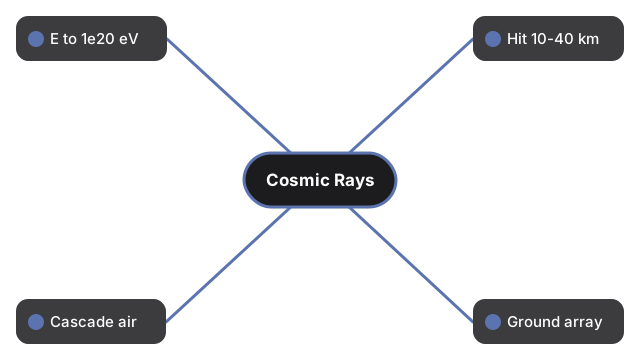
Published literacy: primary energies reach ~10^20 eV; the first interaction is 10 to 40 km up; the particle count peaks near E / 1.5 GeV (billions for the highest energies); and about 150 muons cross every square metre of ground each second.
Drag to orbit and scroll or pinch to zoom. Pause the cascade, or press Replay to fire a fresh shower.
Cosmic Ray Air Shower 3D Explorer
Every second, particles from deep space rain onto the top of the atmosphere. When one high-energy cosmic ray - usually a proton, sometimes a heavier nucleus - hits an air nucleus about 10 to 40 km up, it starts a chain reaction: an extensive air shower. This explorer draws that cascade as a branching tree growing from the first collision down to the ground.
The first hit makes a spray of pions. Neutral pions instantly decay into gamma rays, which seed an electromagnetic sub-shower of electrons, positrons, and photons (drawn in cyan). Charged pions decay into muons (magenta) - heavy, penetrating particles that barely interact, so they reach and even pass below the ground. For the highest-energy primaries the shower peaks at roughly E / 1.5 GeV charged particles - literally billions - before fading. At sea level about 150 muons cross every square metre each second, which works out to roughly one passing through your head every second.
- A branching air-shower cascade from the first interaction to the ground
- Colour-coded particles: orange hadronic core, cyan electromagnetic sub-shower, magenta muons
- The primary track and interaction flash at the top of the atmosphere
- Play or pause the cascade, or Replay to fire a fresh shower
- Facts panel with primary energy, first-interaction height, and ground muon rate
- Runs fully in the browser with the vendored three.js engine - no account, no upload
Students see why a single particle becomes billions; teachers connect pion decay to what detectors measure at the ground; curious readers learn that harmless muons are passing through them right now.
| Figure | Value | Source note |
|---|---|---|
| Primary energy | up to ~10^20 eV | Mostly protons and nuclei |
| First interaction | ~10 to 40 km altitude | Top of the atmosphere |
| Particles at shower max | ~E / 1.5 GeV | Billions for the highest energies |
| Muons at the ground | ~150 per square metre per second | About one/sec through your head |
Everything renders on your device with WebGL. The 3D engine loads once (about 0.7 MB) and is cached; no scene data is sent to a server.
This is an educational visualization - the branching pattern, particle counts, and heights are illustrative, not a Monte-Carlo shower simulation.
For a step-by-step walkthrough, read the Cosmic Ray Air Shower 3D Explorer step-by-step guide. The Space 3D collection also includes Stellar Nucleosynthesis 3D and Gravitational Redshift 3D.
Frequently Asked Questions
What is an extensive air shower?
It is the cascade of secondary particles created when a single high-energy cosmic ray hits the atmosphere. One primary particle can produce billions of secondaries spread over a wide area at the ground.
What are the different particles in the shower?
The hadronic core (orange) is mostly pions. Neutral pions make an electromagnetic sub-shower of electrons, positrons, and photons (cyan). Charged pions decay into muons (magenta), which reach the ground.
Do cosmic ray particles reach the ground?
Yes - muons do. They barely interact with matter, so they penetrate to sea level and below. About 150 muons cross every square metre each second, roughly one through your head per second.
How much energy do cosmic rays carry?
Most are low energy, but the rarest reach about 10^20 electron-volts - a single subatomic particle carrying the energy of a fast tennis serve. The number of shower particles is roughly the primary energy divided by 1.5 GeV.
Who discovered cosmic rays and air showers?
Victor Hess found in 1912 that radiation increases with altitude, pointing to a source beyond Earth. Pierre Auger showed in 1938 that widely separated detectors fire together, revealing extensive air showers.
Is this scene a real simulation?
No. The branching pattern, particle counts, and heights are illustrative so the cascade is easy to see. Real showers are modelled with detailed Monte-Carlo codes.