
Compare all eight planets' real axial tilt side by side, each spinning on its own tilted axis, then click any planet for its exact obliquity.
Published axial tilt figures (NASA Planetary Fact Sheet): Earth 23.44 degrees, Mars 25.19 degrees, Uranus 97.77 degrees.
Drag to orbit and scroll or pinch to zoom. Click any planet for its exact tilt angle, or toggle the tilt-axis lines on or off.
Axial Tilt Comparison 3D Explorer
This browser explorer lines up all eight planets at the same reference size, side by side, each spinning on its own axis tilted to its real, published angle - so you can see at a glance why some planets have strong seasons and others barely have any.
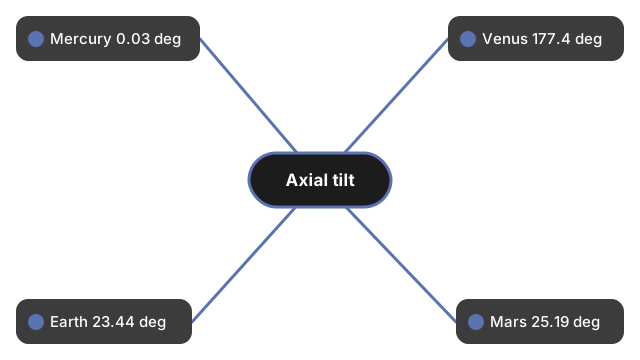
Earth's axis leans 23.44 degrees from vertical, which is why sunlight lands more directly on one hemisphere for half the year and the other for the rest, giving Earth its four seasons. Mars leans a very similar 25.19 degrees, so it has seasons too - just longer ones, because a Martian year runs almost twice as long as Earth's. Jupiter, by contrast, leans only 3.13 degrees, so its huge globe barely tips at all and shows almost no seasonal change.
Two planets stand out. Uranus leans 97.77 degrees - tipped almost onto its side - which astronomers link to an ancient collision with an Earth-sized body soon after the planet formed. Venus is even more extreme in the numbers: it is commonly listed at 177.4 degrees because it spins backwards (retrograde) rather than tilting sharply; recording the retrograde spin as a tilt near 180 degrees is the standard convention rather than describing Venus as having a small tilt with reversed rotation.
- All eight planets drawn at one shared reference size so only the tilt angle is being compared
- Each planet spins on its own axis, tilted to its real, published obliquity
- Click any planet for its exact tilt angle and a one-line cause note
- Toggle the white tilt-axis guide lines on or off
- Drag to orbit the camera, scroll or pinch to zoom
- Runs fully in the browser with the vendored three.js engine - no account, no upload
Students use the row of planets to see why Uranus's seasons are so unlike Earth's; teachers point at Venus to explain the retrograde-rotation convention in one glance; curious readers finally see, side by side, why a small tilt like Jupiter's or Mercury's barely matters while a tilt near Earth's size drives real seasonal change.
| Planet | Axial tilt |
|---|---|
| Mercury | 0.03 degrees |
| Venus | 177.4 degrees (retrograde rotation) |
| Earth | 23.44 degrees |
| Mars | 25.19 degrees |
| Jupiter | 3.13 degrees |
| Saturn | 26.73 degrees |
| Uranus | 97.77 degrees |
| Neptune | 28.32 degrees |
This page is a side-by-side comparison of all eight planets at once. For one planet's extreme tilt in close-up detail, the collection also has the Uranus Tilt 3D Explorer - that page is a single-planet spotlight, while this page is a general comparison across the whole Solar System. For real relative sizes instead of tilt angles, see the Planet Size Comparison 3D Explorer.
Everything renders on your device with WebGL. The 3D engine loads once (about 0.7 MB) and is cached; no scene data is sent to a server.
This is an educational approximation, not a physical simulation - every planet is drawn at the same size purely to make the tilt angle easy to compare.
The depth a single-planet spotlight leaves out
Every planet here is drawn at the same reference size, which isolates the tilt difference from any size illusion - so Uranus's 97.77-degree lean reads immediately against Earth's familiar 23.44 degrees, a contrast the single-planet Uranus spotlight page cannot offer because it has no neighbor to measure against. Click any sphere and the facts panel swaps to that planet's exact angle plus a short cause note, putting Venus's near-180-degree figure (a retrograde-rotation convention, not a true sideways tip) one click away from Uranus's genuine near-98-degree lean for a direct side-by-side check. The tilt-axis toggle beneath the scene switches the white guide lines on or off for all eight planets at once, which is the detail that makes it obvious how shallow Jupiter's 3.13-degree axis cuts compared to the others once every line is visible together. Where the Uranus-only page can spend its whole scene on one collision story in close-up, this comparison trades that depth for breadth, letting a reader drag from Mercury's flat 0.03-degree spin straight to Uranus's near-sideways roll inside a single orbiting camera view.
Frequently Asked Questions
What does the Axial Tilt Comparison 3D Explorer show?
All eight planets drawn at the same reference size, each spinning on its own axis tilted to its real, published obliquity, so you can compare tilt angles side by side.
Why are the planets all the same size in the scene?
This page compares tilt angle only. Drawing every planet at a shared reference radius keeps the comparison focused on the angle, not the size. The Planet Size Comparison 3D Explorer shows real relative sizes instead.
Why is Earth's axial tilt important?
Earth's 23.44-degree tilt is the direct cause of the four seasons - it changes how directly sunlight lands on each hemisphere across the year.
Why does Uranus look tipped over?
Uranus has a real axial tilt of 97.77 degrees - it is tipped almost onto its side. Astronomers think an ancient collision with an Earth-sized body knocked it over shortly after it formed.
Why is Venus listed at 177.4 degrees?
Venus spins backwards (retrograde) rather than having a large tilt in the usual sense. Recording that retrograde spin as a tilt near 180 degrees is the standard astronomical convention.
Is this a physics simulation?
No. It is an educational comparison of real, published tilt angles - each planet spins for clarity, but the scene does not simulate orbital mechanics or climate.