
Scrub a lunar eclipse as the full Moon passes through Earth's penumbra and umbra cones - watch the Danjon redness scale during totality and read published totality and node-alignment figures in the panel.
Play eclipse animates one pass through the shadow in about 12 seconds at 1x; pause and drag the progress slider from 0 to 100 percent to inspect penumbral dimming, partial umbral shadow, and totality.
During totality the Moon tints to the selected Danjon L0-L4 copper-red shade - refracted sunlight through Earth's atmosphere, not a separate texture. Shadow cones are exaggerated for readability; the panel carries maximum totality up to 107 minutes and the node-alignment requirement from NASA eclipse fact sheets.
Lunar Eclipse 3D Explorer
Drag to orbit the view, scroll or pinch to zoom, and press Play eclipse to animate one pass through the shadow. Scrub the progress slider to pause on penumbral dimming, partial umbral shadow, or totality, and pick Danjon L0 through L4 to compare copper-red brightness levels.
The facts panel and the summary table below carry the published figures, all sourced from NASA eclipse fact sheets.
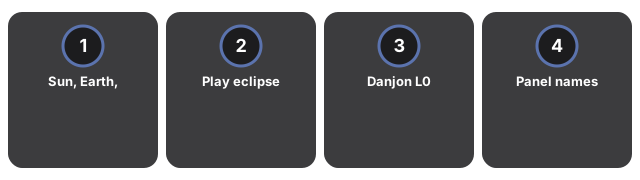
- Sun, Earth, and Moon aligned on one view with visible penumbra and umbra shadow cones
- Play eclipse animates one pass in about 12 seconds at 1x; progress slider scrubs 0 to 100 percent
- Danjon L0-L4 buttons tint totality to published brightness levels from very dark through copper-red
- Panel names each eclipse phase: penumbral, partial umbral, and total with selected Danjon grade
- Real published figures in the panel; shadow cones and distances are compressed and disclosed
- Runs fully in the browser with the vendored three.js engine - no account, no upload
Teachers use it to connect Earth's shadow geometry to the reddish totality color, students compare penumbra versus umbra dimming, and curious readers pause mid-eclipse to read the 107-minute maximum totality figure.
| Quantity | Published value | Source |
|---|---|---|
| Maximum totality duration | up to 107 min | NASA eclipse fact sheets |
| Danjon scale | L0 (very dark) through L4 (copper-red) | NASA eclipse fact sheets |
| Node alignment | Required - Moon must cross the ecliptic near full moon | NASA eclipse fact sheets |
Everything renders on your device with WebGL. The 3D engine loads once (about 0.7 MB) and is cached; no scene data is sent to a server.
The scene is an educational geometry visualization tuned to teach lunar eclipse shadow cones and totality color - it does not match a specific eclipse date, does not predict tonight's sky, and is not an ephemeris. Starting progress is set by the slider, not by a real eclipse calendar.
For a step-by-step walkthrough, read the Lunar Eclipse 3D Explorer step-by-step guide. The Space 3D collection also includes a Moon Phases 3D Explorer for everyday Sun-Earth-Moon phase geometry; a Solar Eclipse 3D Explorer for the Moon's shadow on Earth is planned as a separate page.
Frequently Asked Questions
What does the Lunar Eclipse 3D Explorer show?
Sun, Earth, and Moon aligned on one view while the Moon slides through Earth's penumbra and umbra shadow cones. The panel names each phase - penumbral, partial umbral, and total - and lists maximum totality up to 107 minutes, the Danjon L0-L4 scale, and the node-alignment requirement.
How is this different from the Moon Phases 3D Explorer?
Moon Phases 3D Explorer scrubs a synodic month and shows how the Sun-Earth-Moon angle sets the everyday lit hemisphere and phase name. Lunar Eclipse 3D Explorer is the shadow-cone lesson - Earth's penumbra and umbra dim the full Moon when Sun, Earth, and Moon align near a node, with Danjon redness during totality.
How is this different from a solar eclipse?
A lunar eclipse happens when Earth's shadow falls on the Moon at full moon. A solar eclipse happens when the Moon's shadow falls on Earth at new moon. This page shows the lunar geometry only. A Solar Eclipse 3D Explorer for the Moon's umbra on Earth is planned as a separate Space 3D page.
What is the Danjon scale?
The Danjon scale rates how bright the Moon appears during totality, from L0 (very dark, nearly invisible) through L4 (bright copper-red). Refracted sunlight through Earth's atmosphere tints the Moon; the L0-L4 buttons let you compare published brightness levels during totality.
What real figures does the panel include?
Maximum totality duration up to 107 minutes, the Danjon L0-L4 brightness scale, and that node alignment is required near full moon - all from NASA published eclipse fact sheets.
Is this an ephemeris or matched to tonight's sky?
No. The scene is an educational geometry visualization - it does not match a specific eclipse date, does not predict the next eclipse time, and is not an ephemeris. On-screen shadow cones are exaggerated for readability while the table numbers are real.