
On a truly dark night you can sometimes catch a faint, ghostly triangle of light leaning up from the horizon just after dusk or before dawn. That is the zodiacal light - sunlight bouncing off dust spread through the inner solar system, glowing along the path of the ecliptic.
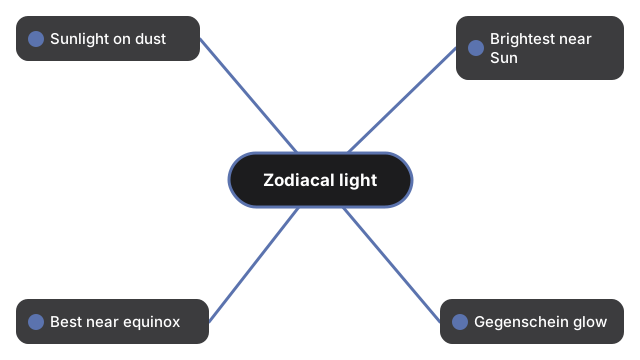
Published literacy: the zodiacal light is scattered sunlight from interplanetary dust near the ecliptic; it looks like a triangular cone brightest near the Sun, is best seen in dark skies around the equinoxes, and is joined high overhead by the faint gegenschein.
Drag to look around and scroll or pinch to zoom. Pause the drift or hide the gegenschein.
Zodiacal Light 3D Explorer
The zodiacal light is one of the sky quiet wonders: a faint, roughly triangular glow that leans up from the horizon after evening twilight or before morning twilight. It is not an aurora and not the Milky Way - it is ordinary sunlight scattering off dust. Countless tiny grains, shed by comets and chipped from asteroids, drift through the inner solar system and settle into a broad lens along the ecliptic, the plane of the planets. This explorer shows why that dust glows and why the glow always follows the same slanted path across the sky.
Because the dust hugs the ecliptic, the light does too. Near the Sun the dust is denser and the scattering stronger, so the glow is brightest and widest close to the horizon where the Sun sits just out of sight, tapering to a dim point higher up. The best views come in dark skies far from city lights, about ninety minutes after sunset in the west or before sunrise in the east - the pre-dawn version has earned the nickname the false dawn. From mid-latitudes the show is easiest near the equinoxes, when the ecliptic stands steeply above the horizon; from the tropics it can appear all year. Look for two fainter companions in the same dusty plane: the zodiacal band stretching across the sky and the gegenschein, a dim oval directly opposite the Sun where dust reflects light straight back at you.
- A ground-level night sky with the dust-scattered cone rising from the horizon
- The glow leaning along the ecliptic, brightest near the hidden Sun
- The faint gegenschein and zodiacal band opposite the Sun
- Toggle the gegenschein and band, or pause the gentle drift
- Facts panel with the cause, shape, and best viewing conditions
- Runs fully in the browser with the vendored three.js engine - no account, no upload
Stargazers learn what that faint triangle really is; students connect it to interplanetary dust and scattering; teachers link it to the ecliptic and the plane of the solar system.
| Feature | What it is | Note |
|---|---|---|
| Zodiacal light | Scattered sunlight on dust | Triangular cone along the ecliptic |
| Brightest part | Near the Sun, at the horizon | Denser dust, stronger scattering |
| Best time | Dark skies near the equinoxes | Steep ecliptic at mid-latitudes |
| Gegenschein | Backscatter opposite the Sun | Very faint oval, needs dark skies |
Everything renders on your device with WebGL. The 3D engine loads once (about 0.7 MB) and is cached; no scene data is sent to a server.
This is an educational visualization - the glow brightness and scale are boosted so the effect is easy to see, and the scene is not to scale.
For a step-by-step walkthrough, read the Zodiacal Light 3D Explorer step-by-step guide. The Space 3D collection also includes Cosmic Ray Shower 3D and Equation of Time 3D.
Frequently Asked Questions
What is the zodiacal light?
It is a faint, triangular glow in the night sky caused by sunlight scattering off interplanetary dust spread along the plane of the solar system.
Why is it shaped like a triangle?
The dust is concentrated near the ecliptic and is densest close to the Sun, so the glow is brightest and widest near the horizon where the Sun has set, tapering to a dim point higher up.
When can I see it?
In dark skies, roughly ninety minutes after sunset in the west or before sunrise in the east. The pre-dawn version is nicknamed the false dawn.
Where does the dust come from?
Mostly from comets shedding material and from collisions between asteroids. Some of it is thought to trace back to dust delivered from the direction of Mars.
What is the gegenschein?
A very dim oval glow directly opposite the Sun, where the same interplanetary dust reflects sunlight straight back toward you. It is part of the same dusty plane.
Is this scene to scale?
No. The brightness and size of the glow are boosted so the effect is easy to see. The real zodiacal light is very faint and needs a genuinely dark sky.