
Moon Calendar 3D Explorer
Scrub through a synodic month on a calendar-style Moon view - watch earthshine on the dark limb, toggle libration wobble, and read phase names plus published libration figures in the panel.
Drag to orbit the view, scroll or pinch to zoom, and slide the calendar day control from 0 to 29.53 to step through new moon, first quarter, full moon, and back. Press Show libration to watch the Moon nod and rock through its published wobble ranges.
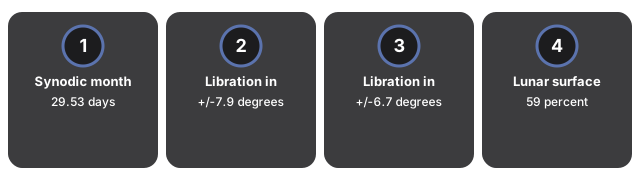
The facts panel names each phase for the selected calendar day and lists real libration figures - longitude +/-7.9 degrees, latitude +/-6.7 degrees, 59 percent of the lunar surface visible over time, and synodic month 29.53 days.
- Calendar day slider from 0 to 29.53 of the synodic month with a live phase name in the panel
- Play button animates one full lunar month in about 30 seconds at 1x
- Earthshine on the dark limb - faint reflected light from Earth on the night side of the Moon
- Libration toggle shows the Moon's nod and rock through published longitude and latitude ranges
- Real published figures in the panel; on-screen Moon size is enlarged and disclosed
- Runs fully in the browser with the vendored three.js engine - no account, no upload
Teachers use it to connect calendar dates to phase names and earthshine, students compare how much of the lunar surface libration reveals over a month, and curious readers pause on full moon to read the 59 percent surface-visibility figure.
| Quantity | Published value | Source |
|---|---|---|
| Synodic month (new moon to new moon) | 29.53 days | NASA Moon Fact Sheet |
| Libration in longitude | +/-7.9 degrees | NASA Moon Fact Sheet |
| Libration in latitude | +/-6.7 degrees | NASA Moon Fact Sheet |
| Lunar surface visible over time | 59 percent | NASA Moon Fact Sheet |
Everything renders on your device with WebGL. The 3D engine loads once (about 0.7 MB) and is cached; no scene data is sent to a server.
The scene is an educational calendar visualization tuned to teach phase names, earthshine, and libration - it does not compute an ephemeris, does not match today's sky, and does not show Sun-Earth-Moon geometry (that is the Moon Phases 3D Explorer). Starting day is set by the slider, not by today's date.
For a step-by-step walkthrough, read the Moon Calendar 3D Explorer step-by-step guide. The Space 3D collection also includes a Moon Phases 3D Explorer for Sun-Earth-Moon geometry and a Solar System 3D Explorer with animated planet orbits.
Frequently Asked Questions
What does the Moon Calendar 3D Explorer show?
A calendar-style Moon view where you scrub through a synodic month by day. The panel names each phase, earthshine tints the dark limb, and a libration toggle shows the Moon's nod and rock through published wobble ranges.
How is this different from the Moon Phases 3D Explorer?
Moon Calendar 3D Explorer focuses on calendar dates, phase names, earthshine, and libration on a single Moon view. Moon Phases 3D Explorer shows Sun-Earth-Moon geometry to teach why phases happen. Use this page for date-and-phase literacy; use Moon Phases for the geometry lesson.
What is earthshine?
Earthshine is faint sunlight reflected from Earth onto the Moon's night side. Near new moon you can see a dim glow on the dark limb - the scene tints that limb to illustrate the effect. It is an educational approximation, not a photometric simulation.
What does the libration toggle show?
Libration is the apparent wobble that lets us see slightly more than one hemisphere of the Moon over time. Press Show libration to watch the Moon nod and rock through published ranges: longitude +/-7.9 degrees and latitude +/-6.7 degrees, revealing about 59 percent of the surface over a synodic month.
What real figures does the panel include?
Synodic month 29.53 days, libration in longitude +/-7.9 degrees, libration in latitude +/-6.7 degrees, and 59 percent of the lunar surface visible over time - all from NASA published fact sheets.
Is this a physics simulation?
The scene is an educational calendar visualization - it does not compute an ephemeris, does not match today's sky, and does not run n-body gravity. On-screen Moon size is enlarged for readability; the table numbers are real.