
In 1995, the Hubble Space Telescope captured one of the most famous astronomical images ever taken: towering columns of gas and dust in the Eagle Nebula, quickly nicknamed the Pillars of Creation. In 2022, the James Webb Space Telescope photographed the same region in infrared light - suddenly the pillars looked far less solid, and many more hidden, still-forming stars came into view. Toggle between the two telescope views below to see the difference for yourself.
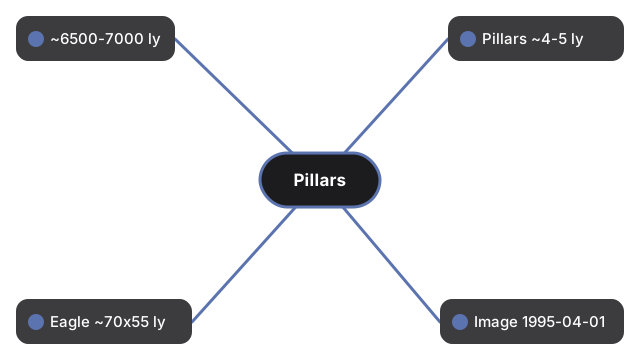
Published figures: the Eagle Nebula sits about 6,500-7,000 light-years away; the pillars themselves stretch roughly 4-5 light-years. Hubble's iconic image was taken 1 April 1995; James Webb's infrared view was unveiled 19 October 2022.
Drag to orbit and scroll or pinch to zoom. Toggle the telescope view, press Play, or change the speed.
Pillars of Creation 3D Explorer
On 1 April 1995, astronomers Jeff Hester and Paul Scowen pointed the Hubble Space Telescope at a small, unassuming patch of the Eagle Nebula and captured what would become one of the most recognized astronomical images ever taken. Towering columns of cold gas and dust, several light-years tall, stood lit from behind by a group of hot young stars just outside the frame - and quickly earned the name Pillars of Creation. Hubble revisited the scene with a sharper camera in 2014, but the view stayed fundamentally the same: dense, dark, almost solid-looking columns, hiding whatever was forming inside and behind them.
That changed in October 2022. The James Webb Space Telescope observed the same patch of sky in infrared light, which slices through dust far more easily than visible light. The pillars suddenly looked far less opaque, and many more young, still-forming stars that Hubble's cameras could never have shown became clearly visible for the first time. The pillars themselves are made of cool hydrogen gas and dust, and they are slowly being eaten away by ultraviolet light from those same nearby hot stars - a process that is expected to erode them completely within roughly 100,000 years.
- The iconic three-pillar composition, rendered in 3D and rotating slowly
- A telescope-view toggle switching between Hubble's opaque visible-light look and James Webb's more transparent infrared look
- Embedded forming stars that stay almost invisible in Hubble mode and glow clearly in James Webb mode
- A speed slider and Play/Pause over the whole rotation
- Runs fully in the browser with the vendored three.js engine - no account, no upload
Anyone who has seen the famous 1995 photograph gets to see, hands-on, exactly what changed in 2022; students see a clear, concrete example of why astronomers use more than one wavelength of light to study the same object.
| Figure | Value | Source note |
|---|---|---|
| Distance | about 6,500-7,000 light-years | Constellation Serpens |
| Pillar height | roughly 4-5 light-years | A small feature within the wider Eagle Nebula |
| Eagle Nebula size | about 70 by 55 light-years | M16 / NGC 6611 |
| First iconic image | 1 April 1995 | Hubble, Hester and Scowen |
| Infrared view | 19 October 2022 | James Webb Space Telescope |
| Expected full erosion | roughly 100,000 years | Ongoing photoevaporation |
Everything renders on your device with WebGL. The 3D engine loads once (about 0.7 MB) and is cached; no scene data is sent to a server.
This is an educational visualization, not a pixel-accurate reproduction of either telescope's image - the pillar shapes, the embedded-star positions, and the erosion glow are illustrative reconstructions built to demonstrate the real, cited visible-versus-infrared difference, not a recreation of the exact photographs.
For a step-by-step walkthrough, read the Pillars of Creation 3D Explorer step-by-step guide. The Space 3D collection also includes Protoplanetary Disk 3D Explorer for another real, ALMA-imaged star-forming region.
Frequently Asked Questions
What are the Pillars of Creation?
Towering columns of gas and dust in the Eagle Nebula, made famous by a 1995 Hubble Space Telescope image.
Why do James Webb's images look so different?
James Webb observes in infrared light, which passes through dust far more easily than the visible light Hubble mainly used, revealing many stars hidden inside and behind the pillars.
How far away are the Pillars of Creation?
About 6,500 to 7,000 light-years, in the constellation Serpens.
How big are the pillars?
Roughly 4 to 5 light-years tall - a small feature within the much larger Eagle Nebula, which spans about 70 by 55 light-years.
What is eroding the pillars?
Ultraviolet light from nearby hot young stars, which is expected to erode them completely within roughly 100,000 years.
What are the bright tips of the pillars?
Evaporating Gaseous Globules, or EGGs - dense knots larger than the Solar System that shield gas behind them and can themselves form new stars.
Is this scene to scale?
No. The pillar shapes and embedded stars are illustrative reconstructions built to demonstrate the real visible-versus-infrared difference, not a pixel-accurate reproduction of either telescope's photograph.