
Toggle between the Earth-centered (Ptolemaic) view and the Sun-centered (Copernican) view of the same real orbits, then scrub time to watch Mars trace its backward loop in the sky.
Both views use the same real orbits: Earth at 1 AU with a 365.25-day year, Mars at 1.52 AU with a 686.98-day year (NASA Planetary Fact Sheet). Only the point you are viewing them from changes.
Drag to orbit and scroll or pinch to zoom. Switch models, press Play or Pause, or drag the day slider to any point across two Mars synodic cycles.
Geocentric vs Heliocentric 3D Explorer
This browser explorer plots the same real Earth and Mars orbits two ways: centered on Earth, the way ancient astronomers saw the sky, or centered on the Sun, the way the orbits actually work - so you can watch Mars trace its famous backward loop and see exactly why it happens.
For about 1,400 years, Ptolemy's Earth-centered model (written down in his Almagest around the 2nd century AD) was the accepted picture of the heavens. It worked well enough for calendars and predictions because Ptolemy added deferent circles and smaller epicycle circles - a circle riding a circle - tuned to reproduce exactly the kind of loop this page draws for Mars. He built that approximation without vector math and without knowing Earth orbits the Sun.
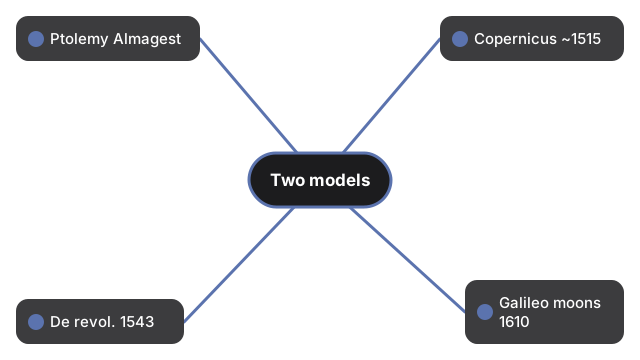
Nicolaus Copernicus proposed a Sun-centered model around 1515 and published it in full in 1543 as De revolutionibus orbium coelestium. Galileo Galilei's discovery of four moons orbiting Jupiter, starting 1610-01-07, showed that not everything in the sky orbits Earth. Johannes Kepler refined the Sun-centered orbits into ellipses, and Isaac Newton's 1687 Principia supplied the physics - gravity - that explained why the Sun-centered picture is the one that matches reality.
- Toggle between the Ptolemaic (Earth-centered) view and the Copernican (Sun-centered) view of the same underlying orbits
- Watch Mars trace a real backward loop in the Earth-centered view near opposition, then flip to the Sun-centered view to see the simple cause: Earth's faster inside orbit overtaking Mars
- Scrub the day slider across two full Mars synodic cycles, or press Play to watch it unfold automatically
- A live readout tells you whether Mars is currently in retrograde (backward) or direct (normal) apparent motion
- Drag to orbit the camera, scroll or pinch to zoom
- Runs fully in the browser with the vendored three.js engine - no account, no upload
History students use the toggle to see, in one view, why a model that turned out to be wrong about the universe's structure still worked well enough to schedule festivals and predict eclipses for over a thousand years. Astronomy learners use it to connect the abstract term "epicycle" to an actual moving picture, instead of just a paragraph in a textbook.
| Milestone | Date / figure |
|---|---|
| Ptolemy's Almagest (geocentric model) | ~2nd century AD; dominant for about 1,400 years |
| Copernicus proposes heliocentrism | around 1515 |
| Copernicus publishes De revolutionibus | 1543 |
| Galileo observes Jupiter's 4 largest moons | starting 1610-01-07 |
| Newton's Principia (settles the physics) | 1687 |
| Mars synodic period (used by this scene) | about 779.9 days |
| Earth / Mars orbital radius (used by this scene) | 1 AU / 1.52 AU |
This page is a side-by-side comparison of the two historical MODELS. For the optical effect explained from Earth's viewpoint only, without the model-history angle, see the Retrograde Motion 3D Explorer instead.
Everything renders on your device with WebGL. The 3D engine loads once (about 0.7 MB) and is cached; no scene data is sent to a server.
This is an educational approximation, not a physical simulation and not a historical reconstruction of Ptolemy's specific epicycle circles - the geocentric view here is built by re-centering the real heliocentric orbits on Earth, which is the same loop his epicycles were designed to approximate.
Frequently Asked Questions
What does the Geocentric vs Heliocentric 3D Explorer show?
The same real Earth and Mars orbits, viewed two ways: centered on Earth (the Ptolemaic model) or centered on the Sun (the Copernican model). Toggling between them shows why Mars appears to loop backward in the sky.
What is retrograde motion, and how does this page relate to it?
Retrograde motion is the backward loop Mars appears to trace against the stars near opposition. This page focuses on the two historical MODELS built to explain it. The Retrograde Motion 3D Explorer covers the optical effect itself from Earth's viewpoint only.
Did Ptolemy's geocentric model actually work?
Well enough for calendars and eclipse predictions to keep it the accepted model for about 1,400 years. His epicycles (circles riding circles) approximated the same loop this page draws directly from the real orbits.
When did the heliocentric model take over?
Copernicus proposed it around 1515 and published it fully in 1543. Galileo's 1610 observation of four moons orbiting Jupiter, and Newton's 1687 law of gravity, provided the evidence and the physics that settled the case.
Does this page draw Ptolemy's actual historical epicycle circles?
No. The geocentric view here is built by re-centering the real heliocentric orbits on Earth, which produces the same loop shape Ptolemy's epicycles approximated. His exact historical epicycle radii for Mars are not a single settled figure, so this page does not present invented numbers as historical fact.
Is this a physics simulation?
No. It is an educational comparison of two historical models using real, published orbital figures - it does not simulate gravity, atmospheres, or any other physical process.