
Explore Saturn's north-polar hexagon - a persistent six-sided jet stream about 30,000 km across. Scrub rotation phase, play/pause the spin, and toggle the rings for context.
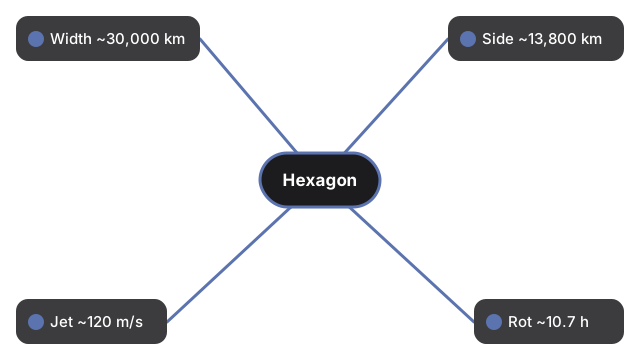
Published teaching figures: width ~30,000 km, side ~13,800 km, jet ~120 m/s (NASA / Cassini literacy). Saturn Rings 3D teaches ring bands; Gas Giant Atmosphere teaches belts - this page teaches the polar hexagon.
Drag to orbit and scroll or pinch to zoom. Scrub rotation phase, play/pause, or toggle rings.
Saturn Hexagon 3D Explorer
This browser explorer shows Saturn's north-polar hexagon as a teaching schematic - not a weather or fluid-dynamics model. Voyager first revealed the six-sided jet; Cassini mapped it in detail. Teaching figures: width about 30,000 km, side about 13,800 km, jet about 120 m/s, with Saturn's System III rotation near 10.7 h.
Scrub rotation phase to spin the globe and jet particles, play/pause the motion, or hide the rings when you want a clearer pole view. Saturn Rings 3D owns ring-band radii; Gas Giant Atmosphere owns belt patterns - this page owns the polar hexagon geometry.
- Saturn globe with a cyan north-polar hexagon
- Jet particles circulating along the six sides
- Rotation-phase scrubber with play/pause
- Optional rings for context (not a ring-band explorer)
- Published ~30,000 km / ~13,800 km / ~120 m/s teaching figures
- Distinct from saturn-rings and gas-giant-atmosphere
- Runs fully in the browser with the vendored three.js engine - no account, no upload
Students see why the polar cloud edge looks hexagonal; teachers link jet speed to the perimeter; curious readers connect Voyager discovery to Cassini follow-up.
| Figure | Value | Source note |
|---|---|---|
| Width across | ~30,000 km | NASA / Cassini literacy |
| Side length | ~13,800 km | Regular-hexagon teaching side |
| Jet speed | ~120 m/s | Polar jet order of magnitude |
| Saturn rotation | ~10.7 h | System III teaching period |
Everything renders on your device with WebGL. The 3D engine loads once (about 0.7 MB) and is cached; no scene data is sent to a server.
This is an educational polar-hexagon schematic - not a fluid-dynamics or weather model.
For a step-by-step walkthrough, read the Saturn Hexagon 3D Explorer step-by-step guide. The Space 3D collection also includes Saturn Rings 3D and Gas Giant Atmosphere 3D.
Frequently Asked Questions
What does the Saturn Hexagon 3D Explorer show?
A teaching schematic of Saturn's north-polar hexagonal jet stream - about 30,000 km across, with sides near 13,800 km and a jet near 120 m/s - with a rotation-phase scrubber.
Who discovered the hexagon?
Voyager spacecraft first revealed the six-sided polar feature in the early 1980s. Cassini later imaged it in much greater detail during its Saturn tour.
How big is the hexagon?
Teaching figures put the width near 30,000 km and each side near 13,800 km - large enough to fit roughly two Earths across.
How is this different from Saturn Rings 3D?
Saturn Rings 3D teaches ring-band radii and structure. This page teaches the north-polar hexagon jet geometry.
How is this different from Gas Giant Atmosphere 3D?
Gas Giant Atmosphere teaches belt and zone banding. This page focuses on the polar hexagon outline and jet particles.
Is this a weather model?
No. It is an educational polar-hexagon schematic - not a fluid-dynamics or atmospheric solver.