Sagittarius A* Star Orbit 3D Explorer vs Kepler Orbits 3D Explorer
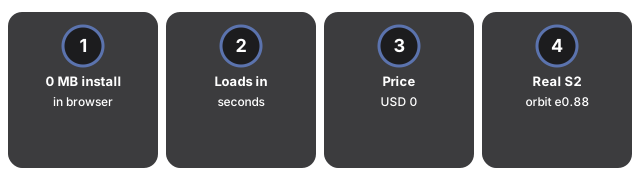
Seeing one real, measured orbit takes one page load in the Sagittarius A* Star Orbit 3D Explorer - 0 MB installed, USD 0, no account. The Kepler Orbits 3D Explorer lets you dial any eccentricity from 0 to 0.97 on a generic Sun-and-planet ellipse, but it does not render one specific, published real-world system.
The numbers side by side
| Aspect | Sagittarius A* Star Orbit 3D Explorer | Kepler Orbits 3D Explorer |
|---|---|---|
| Install size | 0 MB - runs in the browser | 0 MB - runs in the browser |
| Time to first view | Seconds - one page load | Seconds - one page load |
| Price | USD 0 | USD 0 |
| What it renders | One real, published orbit (S2 around Sagittarius A*, e ~0.88, 16.05 yr) | Any eccentricity 0-0.97 on a generic teaching Sun-and-planet ellipse |
Where Sagittarius A* Star Orbit wins
Sagittarius A* Star Orbit wins when the question is "how did astronomers actually measure a black hole's mass" - every figure in its panel is a specific published number from a real observation campaign, not an adjustable teaching example.
Where Kepler Orbits wins
Kepler Orbits wins when the question is about the general shape of Kepler's laws themselves - dialing the eccentricity slider from a near-circle to a comet-like sliver in real time makes the geometry itself the lesson, independent of any one real system.
A reasonable rule
As a reasonable rule, use Kepler Orbits first to build intuition for what eccentricity does to a path, then use Sagittarius A* Star Orbit to see that same geometry applied to a real, measured system with a mass measurement at stake. For the black hole itself rendered artistically, use Black Hole 3D Explorer.
See when to use Sagittarius A* Star Orbit 3D Explorer for session fit.
freetoolonline.com editorial team
Why trust these tools
- Ten-plus years of web tooling. The freetoolonline editorial team has shipped browser-based utilities since 2015. The goal has never changed: get you to a working output fast, without an install.
- No install, no sign-up. Open a tool and get a working output in seconds - nothing to download and no account to create. Tools that need heavy processing run it on our service, so even a low-powered machine gets the job done.
- Analytics stops at the page view. We measure which pages get visited, not what you type or upload inside a tool. There is nothing to sign in to and no profile is attached to your input.
- Open-source core components. The processing engines underneath (libheif, libde265, pdf-lib, terser, clean-css, ffmpeg.wasm, and others) are public and audit-able. We link to each one in its tool page's footer.
- Free, with or without ads. All tools are fully functional without sign-up. The Disable Ads button in the header is always available if you need a distraction-free run.