
Look closely at the Sun surface and it is not smooth - it boils. Bright cells called granules are columns of hot plasma rising from below; the dark lanes between them are cooler plasma sinking back down. Each granule lasts only minutes before a new one replaces it.
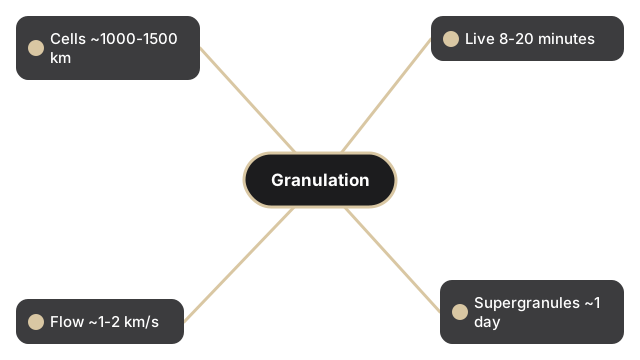
Published literacy: a granule is ~1,000-1,500 km across and lasts 8-20 minutes; about 4 million tile the Sun at once; plasma flows at ~1-2 km/s; and the wider supergranules span ~30,000 km and last about a day.
Drag to orbit and scroll or pinch to zoom. Pause the boiling, or toggle the supergranule overlay.
Solar Granulation 3D Explorer
The face of the Sun looks solid, but a close-up reveals a surface in constant motion - it looks like a pot of boiling porridge. That texture is granulation: the tops of convection columns carrying heat up from the Sun interior. Each bright granule is hot plasma rising; the dark intergranular lanes around it are cooler plasma sinking back down. This explorer draws that boiling pattern, with hundreds of granules brightening and fading the way the real ones do.
A single granule is about 1,000 to 1,500 km across - roughly the size of a large country - yet it lasts only 8 to 20 minutes before it fades and a new one rises in its place. At any moment about 4 million granules tile the visible surface. The plasma streams sideways at roughly 1 to 2 km/s, and the brightness difference between the hot centres and cooler lanes (about 15 percent) is what makes the pattern so striking. Zoom out and a larger pattern appears too: supergranules, about 30,000 km wide and lasting around a day. The DKIST telescope has imaged granulation in stunning detail, and Doppler measurements confirm the rising-and-sinking convective motion.
- A packed field of granules brightening (rising) and fading (sinking)
- Dark intergranular lanes showing where plasma sinks
- A supergranule overlay to reveal the larger convection scale
- Pause the boiling or toggle the supergranules
- Facts panel with granule size, lifetime, flow speed, and supergranule scale
- Runs fully in the browser with the vendored three.js engine - no account, no upload
Students see that the Sun surface is a convecting fluid; teachers connect the bright-and-dark pattern to rising and sinking plasma; curious readers learn that each "grain" is a country-sized column that lives only minutes.
| Figure | Value | Source note |
|---|---|---|
| Granule size | ~1,000-1,500 km | About the size of a large country |
| Lifetime | 8-20 minutes | ~4 million on the Sun at once |
| Flow speed | ~1-2 km/s | Rising centres, sinking lanes |
| Supergranules | ~30,000 km, ~1 day | Larger convection scale |
Everything renders on your device with WebGL. The 3D engine loads once (about 0.7 MB) and is cached; no scene data is sent to a server.
This is an educational visualization - granule sizes, colours, and timing are illustrative, not a radiative-convection simulation.
For a step-by-step walkthrough, read the Solar Granulation 3D Explorer step-by-step guide. The Space 3D collection also includes Sun Structure 3D and Sunspot Magnetic Loops 3D.
Frequently Asked Questions
What is solar granulation?
It is the grainy, boiling texture of the Sun visible surface. Each bright granule is the top of a convection column carrying hot plasma up from inside the Sun.
Why are the lanes between granules dark?
The lanes are where plasma has cooled and is sinking back down. Cooler plasma is dimmer, and because brightness rises steeply with temperature, even a small drop makes the lanes look dark.
How big and how long-lived is a granule?
A typical granule is about 1,000 to 1,500 km across and lasts 8 to 20 minutes before fading. Around 4 million of them cover the Sun at any moment.
What are supergranules?
They are a larger convection pattern, roughly 30,000 km across and lasting about a day, with slower horizontal flows. Toggle the overlay to see their scale next to the granules.
How do we know the plasma is rising and sinking?
Doppler-shift measurements show the bright centres moving toward us (rising) and the dark lanes moving away (sinking), confirming the convective motion. DKIST has imaged the pattern in fine detail.
Is this scene a real simulation?
No. The granule sizes, colours, and timing are illustrative so the boiling pattern is easy to see. Real granulation is modelled with radiative-hydrodynamic simulations.