
Saturn's moon Enceladus hides a saltwater ocean under its ice. Cassini found four long south-polar fractures - the tiger stripes - venting water vapor and ice into space. Press play to watch jets rise from the stripes; toggle the cutaway to see the ice shell and ocean beneath.
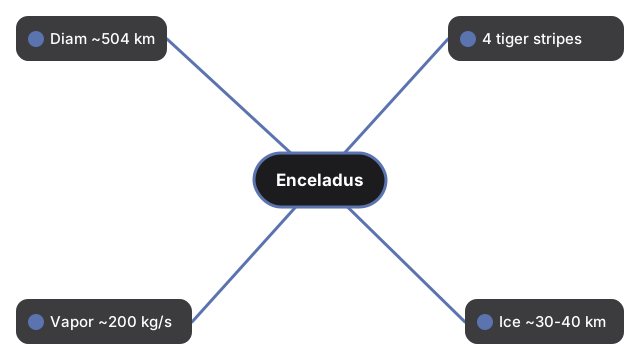
Published figures: diameter ~504 km; four tiger stripes ~135 km long; vapor mass flux ~200 kg/s; ice shell ~30-40 km; south-polar ocean ~10 km deep (Cassini / NASA).
Drag to orbit and scroll or pinch to zoom. Press Play or toggle Cutaway.
Enceladus Geysers 3D Explorer
Enceladus is only about 504 kilometers across, yet Cassini found it venting water into space. Near the south pole, four roughly parallel fractures - informally called tiger stripes, each about 135 kilometers long - open into cryovolcanic jets of water vapor and ice particles. Some of that material falls back as snow; the rest feeds Saturn's diffuse E ring. Gravity and libration measurements later pointed to a global saltwater ocean under the ice, about 30 to 40 kilometers thick at the south pole above a sea roughly 10 kilometers deep.
This explorer shows the icy moon, the four tiger-stripe vents, and rising plume jets. A Cutaway toggle peels the south polar ice to reveal a simplified ocean layer beneath - illustrative, not a full interior model.
- Four tiger-stripe fractures near the south pole
- Animated geyser jets of water vapor and ice
- A Cutaway view of the ice shell and south-polar ocean
- Speed slider and Play/Pause
- Runs fully in the browser with the vendored three.js engine - no account, no upload
Anyone curious about habitability beyond Earth gets a concrete picture of how a small icy moon can still host liquid water and active venting.
| Figure | Value | Source note |
|---|---|---|
| Diameter | ~504 km | Cassini / NASA |
| Tiger stripes | 4 fractures, ~135 km each | South polar terrain |
| Vapor mass flux | ~200 kg/s | UVIS whole SPT |
| Ice shell (south) | ~30-40 km | Cassini gravity |
| Ocean depth (south) | ~10 km | Cassini gravity |
| Discovery of plumes | 2005 | Cassini ISS |
Everything renders on your device with WebGL. The 3D engine loads once (about 0.7 MB) and is cached; no scene data is sent to a server.
This is an educational visualization - moon size, stripe spacing, and ocean thickness are enlarged or simplified for visibility, and the jets are schematic rather than a full hydrodynamic plume model.
For a step-by-step walkthrough, read the Enceladus Geysers 3D Explorer step-by-step guide. The Space 3D collection also includes Tidal Heating 3D Explorer and Saturn Rings 3D Explorer for related Saturn-system context.
Frequently Asked Questions
What are Enceladus's tiger stripes?
Four long fractures near the south pole, each about 135 kilometers long, that vent water vapor and ice into space.
Is there a real ocean under the ice?
Yes - Cassini gravity and libration data support a global saltwater ocean, roughly 10 kilometers deep under about 30-40 kilometers of ice at the south pole.
How much material do the plumes eject?
About 200 kilograms per second of vapor from the south polar terrain as a whole, plus ice particles that help feed Saturn's E ring.
When were the plumes discovered?
Cassini first imaged the south polar activity in detail in 2005.
Does this page model tidal heating?
No. Tidal heating powers the activity in reality, but the detailed flexing math lives on the separate Tidal Heating 3D Explorer.
Is the cutaway to scale?
No. Ice thickness and ocean depth are shown in exaggerated proportions so the layers remain visible.
Are the jets exact Cassini jet maps?
No. They are schematic plumes rising from the four stripes, not the full catalog of 100+ individual jet sources.