
Drag to orbit the view, scroll or pinch to zoom, and press Play orbit to animate one 92.9-minute circuit compressed on screen. Scrub the orbit-phase slider from 0 to 100 percent to pause on any point along the inclined path, and toggle the ground track to compare the yellow subsatellite line with the blue orbit ring in space.
ISS Orbit Tracker 3D Explorer
Watch a procedural International Space Station orbit around Earth - a yellow ground track shows where the station passes over the surface, and the panel lists published altitude, speed, and inclination figures.
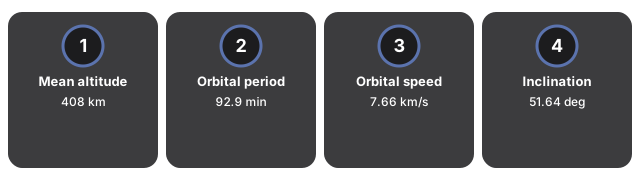
The facts panel lists mean altitude 408 km, orbital period 92.9 min, orbital speed 7.66 km/s, inclination 51.64 deg, and 15.5 orbits per day - all NASA published values for the ISS.
- Procedural ISS orbit at 51.64 deg inclination with a visible ground track on Earth
- Play orbit animates one 92.9-minute circuit compressed on screen; orbit-phase slider scrubs 0 to 100 percent
- Ground-track toggle shows or hides the yellow subsatellite path projected on the surface
- Orbit speed slider from 0.2x to 8x for classroom pacing
- Real published figures in the panel; Earth and orbit sizes are compressed and disclosed
- Runs fully in the browser with the vendored three.js engine - no account, no upload
Teachers use it to connect low-Earth orbit geometry to ground tracks and inclination, students compare how a 51.64 deg tilted ring maps onto latitude bands, and curious readers pause mid-orbit to read the 7.66 km/s speed figure.
| Quantity | Published value | Source |
|---|---|---|
| Mean altitude | 408 km | NASA ISS fact sheets |
| Orbital period | 92.9 min | NASA ISS fact sheets |
| Orbital speed | 7.66 km/s | NASA ISS fact sheets |
| Inclination | 51.64 deg | NASA ISS fact sheets |
| Orbits per day | 15.5 | NASA ISS fact sheets |
Everything renders on your device with WebGL. The 3D engine loads once (about 0.7 MB) and is cached; no scene data is sent to a server.
The scene is an educational orbit visualization tuned to teach ground tracks and LEO inclination - it does not use live telemetry, does not predict tonight's pass times, and is not a physical propagator. Starting phase is set by the slider, not by the real ISS position right now.
For a step-by-step walkthrough, read the ISS Orbit Tracker 3D Explorer step-by-step guide. The Space 3D collection also includes an Earth 3D Globe for a static day/night ground view and a Solar System 3D Explorer with animated planet orbits at a vastly different scale.
Frequently Asked Questions
What does the ISS Orbit Tracker 3D Explorer show?
A procedural International Space Station orbit around Earth at published mean altitude and inclination. A small ISS model circles the inclined path, a yellow ground track shows where the station passes over the surface, and the panel lists NASA figures for altitude, period, speed, and orbits per day.
How is this different from the Earth 3D Globe?
Earth 3D Globe shows a static day/night terminator on a ground view driven by clock time. ISS Orbit Tracker 3D Explorer adds a moving satellite on a tilted low-Earth orbit with a ground track - it teaches orbital mechanics literacy, not live day/night shading on a fixed globe.
How is this different from the Solar System 3D Explorer?
Solar System 3D Explorer animates all eight planets at vastly different orbital scales with compressed sizes for clarity. ISS Orbit Tracker 3D Explorer is a focused LEO station lesson - one inclined orbit at ~408 km altitude with a ground track, not a multi-planet layout.
What is the ground track?
The ground track is the path on Earth's surface directly below the orbiting station. The yellow line projects the ISS subsatellite point as the model moves. Toggle it on or off to compare the surface path with the blue inclined orbit ring in space.
What real figures does the panel include?
Mean altitude 408 km, orbital period 92.9 min, orbital speed 7.66 km/s, inclination 51.64 deg, and 15.5 orbits per day - all from NASA published ISS fact sheets.
Is this live ISS tracking?
No. The scene is an educational orbit visualization - it does not use TLE data, does not show the real ISS position right now, and does not predict pass times. It is not a physical propagator; on-screen sizes are compressed for readability while the table numbers are real.