
Scrub a teaching black-body star's effective temperature and compare Planck-curve shapes from hot blue O stars to cool red M stars, with the Wien peak marked as you go.
The colorful rail is a teaching Planck curve with a Wien-peak marker - an educational spectrum, not a full model atmosphere with absorption lines.
Distinct from Star Lifecycle 3D Explorer (evolution stages over time) and Stellar Magnitude 3D Explorer (apparent vs absolute brightness).
Black Body Radiation 3D Explorer
Black Body Radiation 3D Explorer lets you scrub stellar effective temperature on a teaching black-body star and compare O (about 30,000 K blue) through M (about 3,000 K red) Planck-curve shapes, with the Wien peak tracking the color (constants below).
Drag to orbit, tap O / B / A / F / G / K / M presets, or nudge temperature by 500 K. The facts panel cites Wien's constant and the Sun reference so peak wavelength stays the reliable takeaway.
The scene is an educational visualization - star tint tracks blackbody chromaticity approximately, and the curve has no stellar absorption lines.
- Wien peak l_max = 2.897771955e-3 / T (metres)
- Sun Teff about 5772 K - peak about 502 nm
- O about 30,000 K blue through M about 3,000 K red teaching presets
- Planck curve rail with moving peak marker
- Runs fully in the browser with the vendored three.js engine - no account, no upload
Teachers use it to connect color to temperature, students verify the Sun's green-yellow peak calculation, and curious readers separate blackbody color from evolution timelines or magnitude ladders.
| Quantity | Value | Source |
|---|---|---|
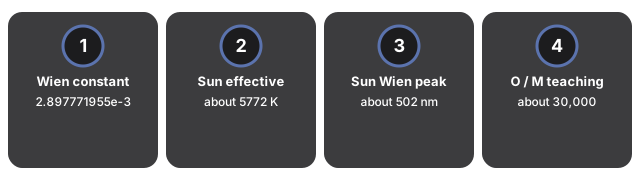
| Wien constant | 2.897771955e-3 m*K | CODATA / standard Wien displacement law |
| Sun effective temperature | about 5772 K | IAU nominal solar values (common Teff) |
| Sun Wien peak | about 502 nm | l_max = b / T |
| O / M teaching Teff | about 30,000 K / about 3,000 K | Standard spectral-type temperature bands |
Everything renders on your device with WebGL. The 3D engine loads once (about 0.7 MB) and is cached; no scene data is sent to a server.
Black Body Radiation 3D Explorer is not a full stellar atmosphere or line-list spectrum, not an interstellar-reddening model, not an evolution timeline, and not a magnitude or distance ladder. For stellar lifetimes open Star Lifecycle 3D Explorer; for brightness ranking open Stellar Magnitude 3D Explorer.
For a step-by-step walkthrough, read the Black Body Radiation 3D Explorer step-by-step guide. The Space 3D collection also includes those sibling explorers.
Frequently Asked Questions
What does Black Body Radiation 3D Explorer show?
A teaching star whose tint and Planck-curve shape follow black-body temperature, with Wien peak l_max = 2.897771955e-3 / T and Sun reference about 5772 K to about 502 nm.
Is this the same as Star Lifecycle 3D Explorer?
No. Star Lifecycle walks evolutionary stages over time. Black Body Radiation ties color to a temperature and a Wien peak on a teaching spectrum.
What is Wien displacement law here?
The peak wavelength of a black-body spectrum satisfies l_max = b / T with b = 2.897771955e-3 m*K. Hotter stars peak at shorter wavelengths.
Why does the Sun peak near 502 nm?
With Teff about 5772 K, Wien law gives about 502 nm - green-yellow peak wavelength in vacuum wavelength teaching units - even though the Sun looks white through the atmosphere.
Are absorption lines included?
No. The curve is a smooth Planck teaching plot. Real stellar spectra have Fraunhofer / molecular lines on top of the continuum.
Does any data leave my device?
No uploads and no login. The vendored three.js engine renders on your device; status and facts stay in the browser.