
A 3D view of the main asteroid belt you can spin, zoom, and explore. Use the buttons below the scene and read the live facts panel on the right.
Play spin rotates the whole belt slowly so gaps and Ceres stay readable; pause and drag to inspect a Kirkwood ring from any angle.
The belt spans about 2.2 to 3.2 AU. Kirkwood gaps sit near 2.50 AU (3:1), 2.82 AU (5:2), and 2.95 AU (7:3). Ceres is about 940 km across and the belt mass is roughly 3% of the Moon. This is an educational belt-structure visualization, not an N-body model.
Asteroid Belt 3D Explorer
Explore the main asteroid belt as a particle ring from 2.2 to 3.2 AU - toggle Kirkwood gap rings at the 3:1, 5:2, and 7:3 Jupiter resonances, highlight Ceres at about 940 km, and spin the view while the panel lists belt mass near 3% of the Moon.
Drag to orbit the view, scroll or pinch to zoom, and press Play spin. Show Kirkwood gaps to mark Jupiter resonances at about 2.50, 2.82, and 2.95 AU, and keep Ceres highlighted as the largest belt body.
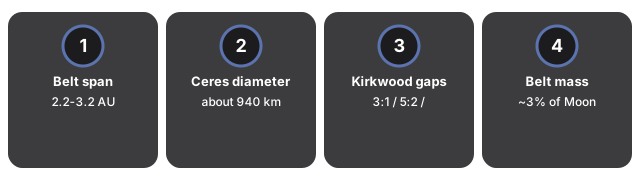
The facts panel lists belt span 2.2-3.2 AU, Ceres about 940 km, Kirkwood gaps 3:1 / 5:2 / 7:3, and belt mass roughly 3% of the Moon from standard planetary references.
- Procedural particle belt around the Sun with compressed thickness
- Show / Hide Kirkwood gap guide rings
- Ceres highlight toggle for the dwarf-planet marker
- Play spin / Pause spin plus speed scrub
- Published belt figures in the facts panel
- Runs fully in the browser with the vendored three.js engine - no account, no upload
Teachers use it to connect belt empties to Jupiter resonances, students locate Ceres among the swarm, and curious readers pause to read mass and diameter figures.
| Quantity | Value | Source |
|---|---|---|
| Belt span | 2.2-3.2 AU | Planetary science |
| Ceres diameter | about 940 km | NASA Dawn / fact sheets |
| Kirkwood gaps | 3:1 / 5:2 / 7:3 | Jupiter mean-motion resonances |
| Belt mass | ~3% of Moon | Literature order of magnitude |
Everything renders on your device with WebGL. The 3D engine loads once (about 0.7 MB) and is cached; no scene data is sent to a server.
The scene is an educational visualization of belt structure - particle count and sizes are compressed, it is not an N-body gravitational model or collision cascade, and it does not list every named asteroid or NEO inventory or place live ephemeris for tonight.
For a step-by-step walkthrough, read the Asteroid Belt 3D Explorer step-by-step guide. The Space 3D collection also includes a Solar System 3D Explorer for the planets, a Comet Orbit 3D Explorer for eccentric tails, and a Tidal Locking 3D Explorer for Moon spin-orbit locking.
Frequently Asked Questions
What does Asteroid Belt 3D Explorer show?
A procedural particle ring for the main asteroid belt from about 2.2 to 3.2 AU, with optional Kirkwood gap guide rings and a Ceres marker about 940 km in diameter in the real figures table.
How is this different from Solar System 3D Explorer?
Solar System 3D Explorer shows the Sun and planets. Asteroid Belt 3D Explorer focuses on the belt population between Mars and Jupiter - gap structure and Ceres - which the planet-only scene does not teach.
What are Kirkwood gaps?
Emptier zones where asteroid orbital periods resonate with Jupiter. The page highlights about 2.50 AU (3:1), 2.82 AU (5:2), and 2.95 AU (7:3).
Is this every real asteroid?
No. Particle count is compressed for readability. The panel carries published span, Ceres size, gap labels, and mass order of magnitude.
Is this an N-body simulation?
No. The scene is an educational visualization of belt structure. It does not integrate gravity, collide bodies, or predict positions for tonight.
Why is belt mass only about 3% of the Moon?
Even though thousands of rocks fill the belt, their combined mass is still small - about 3% of the Moon by standard literature estimates shown in the facts table.