
Explore a teaching chirp of gravitational waves from an inspiraling black-hole binary, with literacy from GW150914 (LIGO, 2015): masses ~36 + 29 Msun, peak strain ~1e-21, chirp ~35-150 Hz.
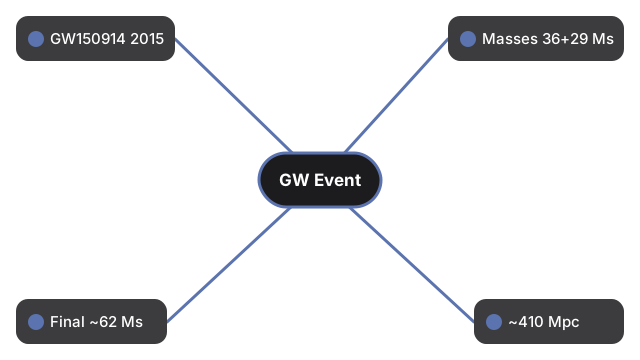
Published literacy: GW150914 masses ~36 + 29 Msun -> ~62 Msun, distance ~410 Mpc (~1.3B ly), peak strain ~1 x 10^-21, chirp ~35-150 Hz.
Drag to orbit and scroll or pinch to zoom. Play / Pause the chirp, change speed, or toggle the exaggerated ripple rings.
Gravitational Waves 3D Explorer
freetoolonline.com editorial team
This browser explorer shows a teaching gravitational-wave chirp from an inspiraling black-hole binary, grounded in GW150914 (LIGO, 2015-09-14): masses ~36 + 29 Msun, peak strain ~1e-21, frequency sweep ~35-150 Hz.
Spacetime Curvature 3D owns static curved-grid geodesics. Gravitational Slingshot 3D owns gravity-assist flybys. This page owns wave chirp literacy from a binary merger.
- Two black holes that spiral inward as the chirp progresses
- Exaggerated ripple rings that expand with rising frequency
- Play / Pause, Slow / Fast, and Reset controls
- Facts panel lists GW150914 masses, 62 Msun remnant, 410 Mpc, 1e-21 strain, 35-150 Hz
- Distinct from spacetime-curvature and gravitational-slingshot
- Runs fully in the browser with the vendored three.js engine - no account, no upload
Students see why a chirp rises before merger; teachers connect strain h ~ 1e-21 to a visible teaching ring; curious readers connect LIGO's first detection to the on-screen inspiral.
| Figure | Value | Source note |
|---|---|---|
| Event | GW150914 (2015-09-14) | LIGO Hanford + Livingston |
| Component masses | ~36 + ~29 Msun | LIGO science summary |
| Final mass | ~62 Msun | Remainder radiated as waves |
| Distance | ~410 Mpc (~1.3B ly) | Published literacy |
| Peak strain h | ~1 x 10^-21 | LIGO educators guide |
| Chirp band | ~35-150 Hz | Observed frequency sweep |
Everything renders on your device with WebGL. The 3D engine loads once (about 0.7 MB) and is cached; no scene data is sent to a server.
This is an educational chirp schematic - not a numerical-relativity waveform solver. Ring sizes exaggerate the real Earth strain (~1e-21) so the pattern is readable.
For a step-by-step walkthrough, read the Gravitational Waves 3D Explorer step-by-step guide. The Space 3D collection also includes Spacetime Curvature 3D and Gravitational Slingshot 3D.
Frequently Asked Questions
What does the Gravitational Waves 3D Explorer show?
A teaching chirp: two black holes spiral inward while exaggerated ripple rings expand. Literacy figures include GW150914 masses ~36 + 29 Msun, peak strain ~1e-21, and chirp ~35-150 Hz.
How is this different from Spacetime Curvature 3D?
Spacetime Curvature 3D teaches a static curved grid and r_s literacy. This page teaches a time-evolving wave chirp from a binary merger.
How is this different from Gravitational Slingshot 3D?
Gravitational Slingshot 3D teaches gravity-assist flybys. This page teaches gravitational-wave strain and chirp frequency from coalescing black holes.
Are the ripple rings the real Earth strain size?
No. Peak strain at Earth is about 1 x 10^-21. The rings are exaggerated so the pattern is visible on one screen.
Is this a numerical-relativity waveform solver?
No. It is an educational chirp schematic - not a full GR waveform integrator.
What is GW150914?
The first direct gravitational-wave detection by LIGO on 2015-09-14, from a ~36 + ~29 Msun black-hole merger about 410 Mpc away.