
No spinning planet is a perfect ball. Rotation flings its equator outward, so it bulges around the middle and flattens at the poles. Saturn shows it best - a clearly squashed shape - while Earth is almost round. Slide the flattening and watch the planet change shape against a perfect-sphere outline.
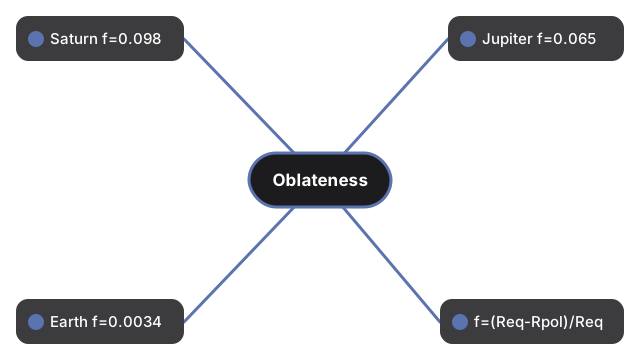
Published literacy: oblateness is f = (equator - pole) / equator; Saturn is the most oblate planet at 0.098, Jupiter is 0.065, and Earth is just 1/298 (about 0.0034, a 21 km bulge) - the faster the spin, the bigger the bulge.
Drag to orbit and scroll or pinch to zoom. Slide the flattening to match Earth, Jupiter, or Saturn, or pause the spin.
Planetary Oblateness 3D Explorer
Gravity wants to pull every planet into a perfect ball, but rotation fights back. As a planet spins, its equator is flung outward, so the planet ends up wider across the middle than from pole to pole. That squashed shape is called oblateness, and this explorer lets you dial it up and down and watch a planet change shape against a perfect-sphere outline.
The amount of flattening is written f = (equator radius - pole radius) / equator radius. The clearest example in the solar system is Saturn, whose fast 10.6-hour spin and low density give it an oblateness of 0.098 - so squashed you can see it in a small telescope. Jupiter is next at 0.065 (spinning in just 9.9 hours), while rocky Earth, turning slowly once every 24 hours, is nearly round at 1/298 - about 0.0034, a bulge of only about 21 kilometres. Because the shape depends on how fast a planet turns and how its mass is spread inside, measuring oblateness tells astronomers about a planet interior. Isaac Newton first worked out that a spinning Earth must be an oblate spheroid back in 1687.
- A planet that spins about its pole and bulges at the equator
- A faint perfect-sphere outline at the pole radius for comparison
- A flattening slider from a round ball to Saturn-level squashing
- Real markers: Earth 0.0034, Jupiter 0.065, Saturn 0.098
- Play to spin the planet, or pause to inspect the shape
- Runs fully in the browser with the vendored three.js engine - no account, no upload
Students see why rotation changes a planet shape; teachers link spin rate to the size of the bulge; the curious learn why Saturn looks squashed and Earth does not.
| Planet | Oblateness f | Spin period |
|---|---|---|
| Saturn | 0.098 (most oblate) | ~10.6 hours |
| Jupiter | 0.065 | ~9.9 hours |
| Earth | 0.0034 (1/298) | 24 hours |
| Formula | f = (R_eq - R_pol) / R_eq | 0 = sphere |
Everything renders on your device with WebGL. The 3D engine loads once (about 0.7 MB) and is cached; no scene data is sent to a server.
This is an educational visualization - one planet is shown at a time, drawn to a common pole radius so the shapes compare cleanly; it is not a planet-size comparison and is not to scale between planets.
For a step-by-step walkthrough, read the Planetary Oblateness 3D Explorer step-by-step guide. The Space 3D collection also includes Gas Giant Atmosphere 3D and Saturn Rings 3D.
Frequently Asked Questions
What is planetary oblateness?
It is how much a planet is flattened at the poles and bulged at the equator, written f = (equator radius - pole radius) / equator radius. A value of 0 means a perfect sphere.
Why do planets bulge at the equator?
Because they spin. Rotation flings material at the equator outward, away from the axis, so the equator sits farther from the center than the poles. The faster the spin, the bigger the bulge.
Which planet is the most oblate?
Saturn, with an oblateness of 0.098. Its fast 10.6-hour spin and low density make it visibly squashed, even in a small telescope. Jupiter is next at 0.065.
How flattened is Earth?
Only slightly. Earth oblateness is about 1/298, or 0.0034 - an equatorial bulge of roughly 21 kilometres. It turns once every 24 hours, far slower than the giant planets.
What does oblateness tell astronomers?
Because the shape depends on spin rate and how mass is distributed inside, oblateness is a clue to a planet interior structure. Newton first predicted a spinning Earth must be oblate in 1687.
Is this scene a size comparison?
No. It shows one planet at a time, drawn to a common pole radius so the shapes compare cleanly. It is not to scale between planets and does not compare their real sizes.