
In 1984 astronomers took the first clear photograph of a disk of dust and debris circling another star - Beta Pictoris. Seen almost edge-on from Earth, the disk reaches out more than 400 AU, and a subtle tilt near the star hinted at a hidden planet years before one was actually photographed. Press play to watch the disk turn, then turn on Warp to see that inner tilt and the real planet, Beta Pictoris b, that causes it.
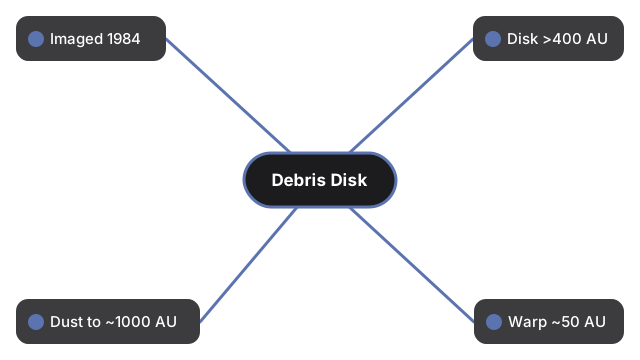
Published figures: the main Beta Pictoris disk reaches more than 400 AU, with fainter dust traced out to about 1,000 AU. The inner disk is warped near 50 AU, and the planet responsible, Beta Pictoris b, orbits at about 9-10 AU.
Drag to orbit and scroll or pinch to zoom. Change the speed, toggle Warp, or pause the motion.
Debris Disk 3D Explorer
In 1983, an infrared satellite noticed that the star Beta Pictoris was glowing more brightly at infrared wavelengths than a star of its type should. A year later, astronomers Bradford Smith and Richard Terrile pointed a telescope equipped with a light-blocking mask at the star and captured something never clearly photographed before - a vast, flattened disk of dust and debris, seen nearly edge-on, stretching more than 400 AU from the star. It was the first direct image of what astronomers now call a debris disk: the dusty aftermath left behind once planet formation is largely finished, kept in constant, gentle collision by leftover asteroid-and-comet-like bodies.
Beta Pictoris turned out to hold a second surprise. Close to the star, the disk is not perfectly flat - it carries a subtle warp, tilting away from the main disk plane within about 50 AU. Astronomers recognized that only the gravity of an unseen planet could bend the disk that way, and they said so years before any planet was actually found. In 2008 and 2009, direct images finally confirmed Beta Pictoris b, a giant planet orbiting at roughly 9 to 10 AU - almost exactly where the warp had predicted a planet should be. The whole system is young, only about 20 to 26 million years old, which is part of why so much dusty debris is still visible instead of having long since been cleared away or ground down.
- A hot young star surrounded by a flattened disk of dust, shown nearly edge-on
- Particle brightness that follows the real reported falloff with distance
- A Warp toggle revealing the inner disk's tilt and the planet that causes it
- A speed slider and Play and Pause control over the slow rotation
- Runs fully in the browser with the vendored three.js engine - no account, no upload
Students see the difference between a still-forming disk and a mature one; astronomy-history readers connect a single warped image to a planet discovery years later; anyone who has heard "debris disk" in passing can see what one actually looks like.
| Figure | Value | Source note |
|---|---|---|
| First imaged | 1984 | Smith and Terrile, Science |
| Main disk radius | more than 400 AU | 1984 discovery image |
| Faint outer dust | traced to about 1,000 AU | Later ground- and space-based imaging |
| Inner warp radius | about 50 AU | Hubble Space Telescope coronagraphy |
| Beta Pictoris b orbit | about 9-10 AU | Direct imaging, confirmed 2008-2009 |
Everything renders on your device with WebGL. The 3D engine loads once (about 0.7 MB) and is cached; no scene data is sent to a server.
This is an educational visualization, not a dust-collision simulation - the inner warp is exaggerated for clarity, the planet marker is enlarged, and the rotation is heavily sped up; the real outer disk takes thousands of years to complete one turn.
For a step-by-step walkthrough, read the Debris Disk 3D Explorer step-by-step guide. The Space 3D collection also includes Protoplanetary Disk 3D, which shows the earlier, still-forming stage of a disk like this one.
Frequently Asked Questions
What is a debris disk?
A flattened ring of dust and small bodies left over after planet formation is largely finished, kept replenished by ongoing collisions between leftover asteroid-and-comet-like objects.
What makes Beta Pictoris special?
It was the first star ever directly photographed with a clear circumstellar disk, imaged in 1984 after an infrared satellite had detected unusual heat a year earlier.
How big is the disk?
The main disk reaches more than 400 AU from the star, with fainter dust traced out to about 1,000 AU in later observations.
What caused the disk's inner warp?
The gravity of a planet. Astronomers inferred a hidden planet from the tilt near 50 AU years before any planet was directly imaged there.
Was the predicted planet ever found?
Yes. Beta Pictoris b was confirmed by direct imaging in 2008 and 2009, orbiting at roughly 9 to 10 AU, close to where the warp had pointed.
How old is the system?
About 20 to 26 million years, young enough that a large amount of debris is still visible.
Is this scene to scale?
No. The inner warp is exaggerated for clarity, the planet marker is enlarged, and the rotation is heavily sped up compared to the real system.