
Light climbing out of a gravity well loses energy and shifts toward the red - and a clock deep in the well ticks slower than one far away. This is gravitational redshift, a cornerstone prediction of general relativity.
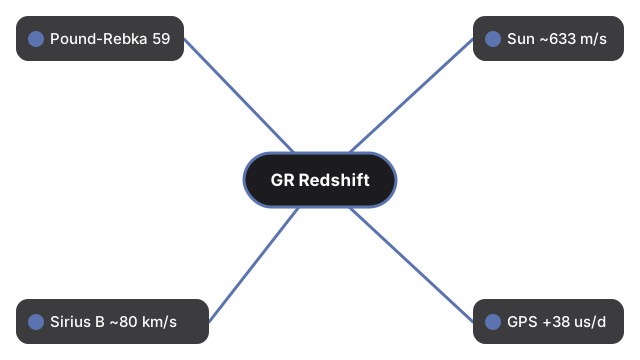
Published literacy: Pound and Rebka measured the shift over a 22.5 m tower in 1959 (about 2.5e-15); the Sun redshift is ~633 m/s equivalent (2 parts per million); Sirius B shows ~80 km/s; GPS clocks run ~38 microseconds/day faster.
Drag to orbit and scroll or pinch to zoom. Toggle the clocks, hide the wave, or switch to stronger gravity to exaggerate the redshift.
Gravitational Redshift 3D Explorer
A photon leaving a star has to climb out of the star gravity well, and climbing costs energy. Because a photon cannot slow down, it pays that cost by stretching its wavelength - it shifts toward the red. The same effect means a clock deep in a gravity well runs slower than one higher up. This explorer draws a light wave rising out of a massive body: tightly packed and blue near the surface, stretched and red at the top, with two clocks ticking at different rates.
The effect is tiny near everyday masses but real and measured. In 1959 Pound and Rebka sent gamma rays up a 22.5 metre tower at Harvard and detected a fractional shift of about 2.5 x 10^-15, confirming general relativity to roughly 10 percent. The Sun produces a redshift of about 633 m/s in Doppler-equivalent units (only about 2 parts per million, and easily masked by convection). The white dwarf Sirius B - a Sun packed into an Earth-sized ball - shows about 80 km/s. And every GPS satellite clock runs about 38 microseconds per day faster than one on the ground; without that correction, positioning would drift badly within hours.
- A light wave climbing out of a gravity well, reddening as it rises
- Photon packets that shift from blue to red as they climb
- Two clocks - one deep, one high - ticking at different rates
- A stronger-gravity toggle that exaggerates the redshift and the clock gap
- Facts panel with Pound-Rebka, the Sun, Sirius B, and GPS figures
- Runs fully in the browser with the vendored three.js engine - no account, no upload
Students see that redshift is not only about motion (Doppler) but also about gravity; teachers connect the wave picture to the clock picture; curious readers learn why GPS would fail without general relativity.
| Figure | Value | Source note |
|---|---|---|
| Pound-Rebka (1959) | 22.5 m; shift ~2.5e-15 | Confirmed GR to ~10% |
| The Sun | ~633 m/s equivalent | About 2 parts per million |
| Sirius B (white dwarf) | ~80 km/s | Hubble 80.4 +/- 4.8 km/s |
| GPS satellites | ~38 microseconds/day faster | Uncorrected -> fails in hours |
Everything renders on your device with WebGL. The 3D engine loads once (about 0.7 MB) and is cached; no scene data is sent to a server.
This is an educational visualization - the wavelengths, clock rates, and the depth of the well are exaggerated for clarity, and the scene is not a numerical relativity simulation.
For a step-by-step walkthrough, read the Gravitational Redshift 3D Explorer step-by-step guide. The Space 3D collection also includes Spacetime Curvature 3D and Black Hole 3D.
Frequently Asked Questions
What is gravitational redshift?
It is the shift of light toward longer, redder wavelengths as it climbs out of a gravity well. The photon loses energy to the gravitational field, so its frequency drops.
How is it different from Doppler redshift?
Doppler redshift comes from motion - the source moving away. Gravitational redshift comes from the difference in gravitational potential between where the light is emitted and where it is received, even if nothing is moving.
Why do clocks run slower deep in a gravity well?
Redshift and time dilation are two views of the same effect. If a wave arrives with a lower frequency, fewer cycles reach you per second, which means time itself ran slower where the light came from.
How was it first measured on Earth?
The Pound-Rebka experiment in 1959 sent gamma rays up a 22.5 metre tower and used the Mossbauer effect to detect a fractional shift of about 2.5 x 10^-15, confirming general relativity to about 10 percent.
What does this have to do with GPS?
GPS satellite clocks sit higher in Earth gravity well, so they tick about 38 microseconds per day faster than clocks on the ground. The system corrects for this, or positions would drift badly within hours.
Is the scene physically exact?
No. The wavelengths, clock rates, and the depth of the well are exaggerated so the effect is visible. Real gravitational redshift near a star or planet is far too small to see by eye.