
Pick a body - Moon, Earth, Jupiter, or Sun - and the embedding-diagram sheet deepens to match its escape speed. Toggle the Sun's r_s ring to place its Schwarzschild radius on the same picture.
The deformed sheet is a teaching embedding diagram - a rubber-sheet style picture of a potential well. Deeper wells match larger published escape velocities.
Distinct from Black Hole 3D Visualizer: that page shows an accretion disk and horizon art; this page compares escape-speed wells for familiar Solar System bodies plus r_s literacy for the Sun.
Gravity Well 3D Explorer
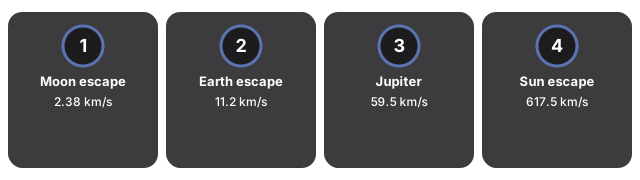
Compare gravity wells for the Moon, Earth, Jupiter, and the Sun - escape velocities 2.38, 11.2, 59.5, and 617.5 km/s - on an embedding-diagram sheet, and see how r_s = 2GM/c^2 marks the Sun's Schwarzschild radius (~2.95 km).
Drag to orbit the view, scroll or pinch to zoom, and tap Moon / Earth / Jupiter / Sun to change well depth. Show r_s (Sun) places a teaching ring sized for literacy, not geographic scale.
The facts panel lists published escape velocities and the Schwarzschild formula reminder so the funnel stays an educational comparison, not a full general-relativity solver.
- Embedding-diagram sheet that deforms with selected body
- Escape velocities: Moon 2.38, Earth 11.2, Jupiter 59.5, Sun 617.5 km/s
- Optional Sun r_s ring (~2.95 km real value, exaggerated on screen)
- Distinct from Black Hole 3D Visualizer and Gravity Orbit Golf
- Runs fully in the browser with the vendored three.js engine - no account, no upload
Teachers use it to rank escape speeds visually, students connect r_s = 2GM/c^2 to the Sun without a textbook plot, and curious readers separate rubber-sheet intuition from accretion-disk imagery.
| Quantity | Value | Source |
|---|---|---|
| Moon escape velocity | 2.38 km/s | Standard planetary data (surface escape) |
| Earth escape velocity | 11.2 km/s | Standard planetary data (surface escape) |
| Jupiter escape velocity | 59.5 km/s | Standard planetary data (1 bar / cloud-top approx) |
| Sun escape velocity | 617.5 km/s | Photosphere escape (standard solar data) |
| Sun Schwarzschild radius | about 2.95 km | r_s = 2GM/c^2 |
Everything renders on your device with WebGL. The 3D engine loads once (about 0.7 MB) and is cached; no scene data is sent to a server.
The scene is an educational visualization - well depth is a log-scaled teaching proxy so Moon and Sun fit one view, not a Newtonian multipole or GR embedding solve.
For a step-by-step walkthrough, read the Gravity Well 3D Explorer step-by-step guide. The Space 3D collection also includes a Black Hole 3D Visualizer for disk/horizon imagery and a Solar System 3D Explorer for orbiting planets.
Frequently Asked Questions
What does Gravity Well 3D Explorer show?
An embedding-diagram sheet that deepens when you pick the Moon, Earth, Jupiter, or Sun, using published escape velocities 2.38, 11.2, 59.5, and 617.5 km/s, plus an optional Sun r_s teaching ring.
Is this the same as Black Hole 3D Visualizer?
No. Black Hole 3D Visualizer focuses on accretion-disk and horizon imagery. Gravity Well compares escape-speed wells for familiar bodies and states the r_s = 2GM/c^2 literacy for the Sun.
What is escape velocity?
The speed needed to leave a body without further thrust, from a stated radius (here, surface or photosphere values from standard planetary data): Earth about 11.2 km/s, Moon about 2.38 km/s.
What does r_s = 2GM/c^2 mean here?
The Schwarzschild radius. For the Sun it is about 2.95 km. The on-screen ring is exaggerated so you can see it; the number in the facts panel is the published figure.
Is the funnel a real spacetime simulation?
No. It is a rubber-sheet teaching diagram with log-scaled depth so Moon and Sun fit one view. The copy states that honesty so escape speeds stay the reliable takeaway.
Does any data leave my device?
No uploads and no login. The vendored three.js engine renders on your device; status and facts stay in the browser.