
The stars look fixed, but they are not. Each one drifts slowly across the sky - its proper motion - so the shapes we know are temporary. Scrub time forward and back and watch the Big Dipper bend out of shape, because two of its seven stars drift against the other five.
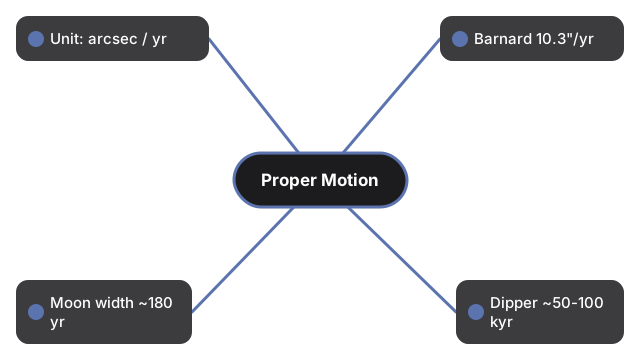
Published literacy: proper motion is a star drift across the sky in arcseconds per year; Barnard Star leads at 10.3 arcsec/yr (a full-Moon width in about 180 years); the Big Dipper becomes unrecognizable over roughly 50,000 to 100,000 years.
Drag to orbit and scroll or pinch to zoom. Scrub the year slider, press Play, or hide the drift arrows.
Stellar Proper Motion 3D Explorer
Over a human lifetime the night sky looks changeless, but it is not. Every star is moving, and its slow drift across our line of sight is called proper motion, measured in arcseconds per year. This explorer lets you scrub tens of thousands of years forward and back and watch a shape everyone knows - the Big Dipper - slowly bend and break apart.
The reason is beautifully simple. Five of the seven bright stars in the Dipper belong to the Ursa Major Moving Group and travel together, but the two on the ends - Dubhe at the lip of the bowl and Alkaid at the tip of the handle - are just passing through and drift the other way. Give it 50,000 to 100,000 years and the familiar outline is gone. The champion drifter in our skies is Barnard Star, a faint red dwarf only about six light-years away: it covers 10.3 arcseconds every year, enough to cross a full-Moon width in roughly 180 years. A big proper motion almost always means a star is nearby rather than unusually fast, because the closer a star is, the more its real motion shows up as angle in our sky.
- A top-down star field with the seven Big Dipper stars connected as the asterism
- A year slider to scrub roughly 100,000 years into the past or future
- Green arrows showing each star drift direction (its proper motion)
- The two amber stars (Dubhe, Alkaid) drifting against the five blue-white ones
- Play to auto-sweep the years, or hide the drift arrows
- Runs fully in the browser with the vendored three.js engine - no account, no upload
Stargazers see why constellations are not permanent; students connect proper motion to distance and space velocity; teachers show the Ursa Major Moving Group in action.
| Figure | Value | Source note |
|---|---|---|
| Proper motion unit | arcseconds per year | Drift across the line of sight |
| Barnard Star | 10.3 arcsec/yr | Highest known; ~6 ly away |
| Full-Moon width | ~180 years | Time for Barnard to cross it |
| Big Dipper reshapes | ~50,000-100,000 yr | Dubhe + Alkaid vs the group |
Everything renders on your device with WebGL. The 3D engine loads once (about 0.7 MB) and is cached; no scene data is sent to a server.
This is an educational visualization - star positions and drift arrows are schematic so the effect is easy to see, and the scene is not to scale.
For a step-by-step walkthrough, read the Stellar Proper Motion 3D Explorer step-by-step guide. The Space 3D collection also includes Stellar Parallax 3D and Star Trails 3D.
Frequently Asked Questions
What is proper motion?
It is the slow drift of a star across the sky, measured across our line of sight in arcseconds per year. It is separate from any motion toward or away from us.
Why does the Big Dipper change shape?
Five of its seven stars share a common drift as the Ursa Major Moving Group, but Dubhe and Alkaid do not. Over tens of thousands of years their opposite drift pulls the familiar outline apart.
Which star moves fastest across the sky?
Barnard Star, a faint red dwarf about six light-years away, with a proper motion of 10.3 arcseconds per year - enough to cross a full-Moon width in about 180 years.
Does fast proper motion mean the star is fast?
Not necessarily. A large proper motion usually means the star is nearby, so its real motion shows up as a bigger angle in our sky. A distant star moving just as fast would appear to barely shift.
How is this different from parallax or star trails?
Parallax is a tiny yearly wobble from Earth orbit; star trails are nightly arcs from Earth spin. Proper motion is the star own real drift across the sky over years and centuries.
Are the star positions accurate?
They are schematic - arranged and scaled so the effect is easy to see. The physics is real: the Ursa Major Moving Group binds five stars while Dubhe and Alkaid drift on their own.