
On 17 August 2017, two neutron stars merged in a distant galaxy - and for the first time ever, the same event was caught in both gravitational waves and light. A short burst of gamma rays arrived just 1.74 seconds after the gravitational-wave signal ended, then, eleven hours later, telescopes found a real point of light that slowly turned from blue to red over the following days. Press play to watch the merger, the brief gamma-ray flash, and the kilonova's real color change unfold.
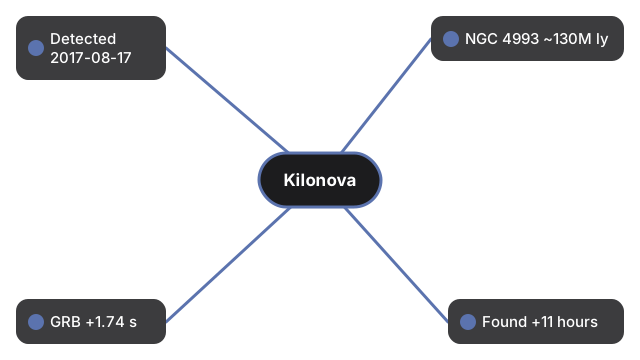
Published figures: GW170817 (LIGO/Virgo, 17 Aug 2017) in galaxy NGC 4993, about 130-140 million light-years away. Gamma-ray burst GRB 170817A arrived 1.74 seconds after the gravitational-wave signal ended. The kilonova AT2017gfo was found 11 hours later and visibly reddened over about 10 days.
Drag to orbit and scroll or pinch to zoom. Scrub the day slider, press Play, or toggle the GRB jet.
Kilonova 3D Explorer
On 17 August 2017, the LIGO and Virgo gravitational-wave detectors picked up the unmistakable signal of two neutron stars spiraling together in a galaxy called NGC 4993, roughly 130 to 140 million light-years away. What happened next made history. Just 1.74 seconds after that gravitational-wave signal ended, space telescopes recorded a short burst of gamma rays - arriving so close behind that scientists could finally pin down, far more precisely than ever before, that gravity and light travel at exactly the same speed.
Eleven hours later, ground-based telescopes found something no gravitational-wave detector alone can ever show: an actual point of light at the merger site, later named AT2017gfo. Over the following days it did something remarkable - it visibly changed color, fading from a hot blue-white glow toward a deep red as the wreckage of the two neutron stars expanded and cooled. Astronomers call this glow a kilonova, and it is powered by the radioactive decay of newly made heavy elements. This single event confirmed that neutron-star mergers are a major source of elements heavier than iron in the universe - an estimated 10,000 or more Earth masses of new heavy elements, including roughly 10 Earth masses of gold and platinum, are thought to have formed in the wreckage.
- Two neutron stars spiraling together, then a merger flash
- A brief gamma-ray jet timed to the real 1.74-second delay story
- An expanding kilonova cloud that visibly reddens on the real roughly-10-day timescale
- A Day slider (0-14) plus Play/Pause and a GRB-jet toggle
- Runs fully in the browser with the vendored three.js engine - no account, no upload
Students see why this was the first event ever caught in both gravitational waves and light; anyone curious where gold actually comes from gets a direct answer; readers of the Gravitational Waves 3D page (which shows two black holes merging into total darkness) see exactly why neutron stars are different: there is real matter left to see.
| Figure | Value | Source note |
|---|---|---|
| Detected | 17 August 2017 (LIGO/Virgo) | GW170817 |
| Host galaxy | NGC 4993, about 130-140 million ly | Multiple distance estimates |
| Gamma-ray burst delay | 1.74 seconds after the merger | GRB 170817A, Fermi and INTEGRAL |
| Kilonova found | 11 hours later | AT2017gfo, Swope Telescope |
| Color change | blue to red over about 10 days | Multi-observatory follow-up |
| Heavy elements formed | on the order of 10,000+ Earth masses | Includes about 10 Earth masses of gold and platinum |
Everything renders on your device with WebGL. The 3D engine loads once (about 0.7 MB) and is cached; no scene data is sent to a server.
This is an educational visualization, not a hydrodynamic simulation - the inspiral shown is brief and schematic (see Kepler Orbits 3D or Gravitational Waves 3D for orbit and chirp detail), the gamma-ray jet's beam angle is illustrative rather than the real narrow geometry, and ejecta expansion speed and size are compressed for legibility.
For a step-by-step walkthrough, read the Kilonova 3D Explorer step-by-step guide. The Space 3D collection also includes Gravitational Waves 3D, which shows the black-hole-merger case where there is no matter left to see.
Frequently Asked Questions
What is a kilonova?
The glow left behind when two neutron stars merge, powered by the radioactive decay of newly made heavy elements in the ejected wreckage.
What was GW170817?
The gravitational-wave signal from two neutron stars merging, detected by LIGO and Virgo on 17 August 2017 - the first event ever seen in both gravitational waves and light.
Why does the 1.74-second delay matter?
A gamma-ray burst arrived only 1.74 seconds after the gravitational-wave signal ended, letting scientists confirm gravity and light travel at essentially the same speed - a huge improvement over the previous best measurement.
Why does the color change over time?
The kilonova starts hot and blue, then cools and expands, turning visibly red over about 10 days as heavier, more light-absorbing elements dominate the glow.
Did this event really make gold?
Evidence strongly suggests it did. An estimated 10,000 or more Earth masses of elements heavier than iron are thought to have formed, including roughly 10 Earth masses of gold and platinum.
Why doesn't a black-hole merger look like this?
Two merging black holes have no matter to eject or heat, so they produce gravitational waves but no light show. Two merging neutron stars have real matter, so they produce both.
Is this scene to scale?
No. The inspiral is brief and schematic, the gamma-ray jet's angle is illustrative, and the ejecta's expansion speed and size are compressed for legibility.