
Line up the Sun, Moon and Earth and you have a new moon. The Moon then circles Earth once against the stars in 27.3 days - the sidereal month - but that is not enough to bring back the new moon, because Earth has slid along its own orbit in the meantime. The Moon needs about 2.2 more days to catch up with the Sun, giving the 29.5-day synodic month that sets the rhythm of the phases. Press play and watch one orbit fall short.
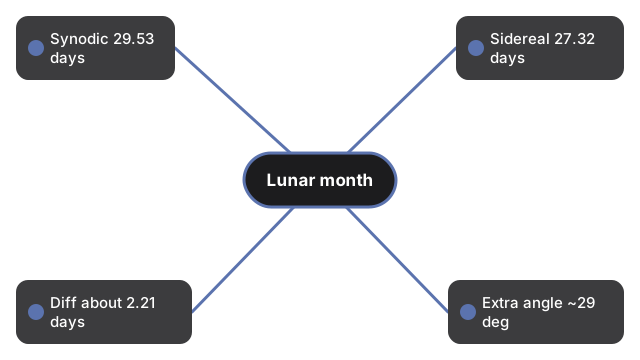
Published literacy: the synodic month (new moon to new moon) averages 29.53 days, while the sidereal month (one orbit relative to the stars) is 27.32 days. The gap of about 2.2 days exists because the Moon, moving 13.18 degrees a day, must cover an extra 29 degrees to catch the Sun after Earth has advanced 0.99 degrees a day along its orbit.
Drag to orbit and scroll or pinch to zoom. Change the speed, hide the Moon path, reset to a fresh new moon, or pause the motion.
Synodic Lunar Month 3D Explorer
Ask how long a month is and the sky gives two answers. Relative to the distant stars, the Moon finishes one loop around Earth in 27.3 days - the sidereal month. But the calendar month people actually feel, from one new moon to the next, is longer: 29.5 days, the synodic month. This explorer shows why. It starts you at new moon, with the Sun, Moon and Earth in a line, then plays the two orbits at once so you can watch the Moon complete a star-loop and still fall short of the Sun.
The reason is motion stacked on motion. While the Moon circles Earth, Earth is sweeping along its own orbit around the Sun at about 0.99 degrees a day. So after the Moon has come back to the same spot against the stars, the Sun has shifted; the Moon, travelling about 13.18 degrees a day, has to cover roughly 29 more degrees - about 2.2 extra days - to line up with the Sun again for the next new moon. That is why a year holds about 13.37 sidereal months but only about 12.37 synodic months, and why the phase calendar and the star calendar never quite agree.
- A top-down Sun, an Earth on its orbit, and a Moon circling Earth
- A yellow Sun line and a blue fixed-star line that start together at new moon and slowly split apart
- Live counters for sidereal months and synodic new moons, with the 2.2-day gap called out
- A traced Moon path that draws the looping curve of the two combined motions
- A speed slider, a reset to fresh new moon, and Moon-phase shading from the real Sun light
- Runs fully in the browser with the vendored three.js engine - no account, no upload
Students see why a lunar orbit and a lunar month differ; teachers link the 2.2-day gap to Earth own motion; calendar makers see the root of leap months.
| Figure | Value | Source note |
|---|---|---|
| Synodic month | 29.53 days (29 d 12 h 44 m) | New moon to new moon |
| Sidereal month | 27.32 days (27 d 7 h 43 m) | One orbit vs the stars |
| Difference | about 2.21 days | Synodic is longer |
| Extra angle to catch the Sun | about 29 degrees | At 13.18 deg per day |
Everything renders on your device with WebGL. The 3D engine loads once (about 0.7 MB) and is cached; no scene data is sent to a server.
This is an educational visualization - the Moon orbit is drawn far larger than real and the motion is sped up, so both cycles finish in seconds; angles and periods are real but distances are not to scale, and eclipses and orbit tilt are not shown.
For a step-by-step walkthrough, read the Synodic Lunar Month 3D Explorer step-by-step guide. The Space 3D collection also includes Moon Phases 3D and Moon Calendar 3D.
Frequently Asked Questions
What is a synodic month?
It is the time from one new moon to the next, averaging 29.53 days (29 days 12 hours 44 minutes). Because the phases depend on the Sun-Moon-Earth angle, this is the cycle of the lunar phases.
What is a sidereal month?
It is the time the Moon takes to return to the same position against the fixed stars, about 27.32 days (27 days 7 hours 43 minutes). That is one true orbit of Earth.
Why is the synodic month longer?
While the Moon orbits Earth, Earth moves along its own orbit around the Sun. After one star-orbit the Sun has shifted, so the Moon needs about 2.2 more days to line up with the Sun again.
How much farther must the Moon travel?
About 29 degrees more. The Moon moves roughly 13.18 degrees a day, so covering that extra angle takes the 2.2-day difference between the two months.
How many months are in a year?
About 13.37 sidereal months but only about 12.37 synodic months fit in a year, which is why lunar calendars drift against the solar year and sometimes add a leap month.
Is this scene to scale?
No. The Moon orbit is drawn far larger than real (the true ratio is about 390 to 1) and the motion is sped up so both cycles finish in seconds. The angles and periods are real; distances are not, and eclipses are not shown.