
As Earth orbits the Sun, a nearby star seems to shift back and forth against the far background - stellar parallax. The tinier the shift, the farther the star, so this angle is the first rung of the cosmic distance ladder: the parsec.
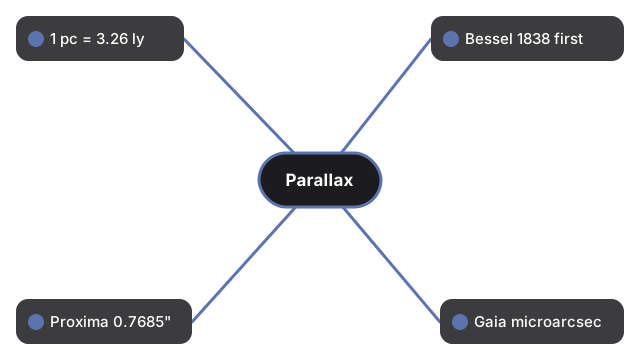
Published literacy: one parsec is 3.26 light-years (1 AU subtends 1 arcsecond); Bessel first measured parallax in 1838 (61 Cygni, 0.314 arcsec); the nearest star Proxima Centauri sits at 0.7685 arcsec; every stellar parallax is under 1 arcsecond.
Drag to orbit and scroll or pinch to zoom. Pause the orbit, hide the sight line, or toggle the parallax-ellipse trace.
Stellar Parallax 3D Explorer
Hold up a finger and blink between your eyes: it jumps against the background. Stars do the same thing as Earth moves from one side of its orbit to the other - a nearby star shifts against the distant background. That shift is stellar parallax, and it is the most direct way to measure the distance to a star. This explorer shows the Sun, Earth on its orbit, a nearby star, and the little parallax ellipse the star traces against the background over a year.
The angle is astonishingly small. A parsec - the natural unit here - is the distance at which the radius of Earth orbit (1 AU) subtends just one arcsecond, which works out to 3.26 light-years. The distance in parsecs is simply 1 divided by the parallax in arcseconds. Even the nearest star, Proxima Centauri, has a parallax of only 0.7685 arcsec (about 4.24 light-years). Every star has a parallax below one arcsecond, which is why it took about two thousand years from first idea to first measurement: Friedrich Bessel finally pinned down 61 Cygni at 0.314 arcsec in 1838. Today the Gaia spacecraft measures parallaxes to a few microarcseconds for around a billion stars.
- The Sun, Earth on its orbit, and a nearby star against a distant background
- The parallax ellipse the nearby star traces over one year
- A sight line from Earth through the star to its apparent background position
- Pause the orbit, hide the sight line, or toggle the ellipse trace
- Facts panel with the parsec, Bessel 1838, Proxima Centauri, and Gaia
- Runs fully in the browser with the vendored three.js engine - no account, no upload
Students see why closer stars shift more; teachers connect the geometry to the parsec definition; curious readers learn that the whole cosmic distance ladder starts with this simple triangle.
| Figure | Value | Source note |
|---|---|---|
| 1 parsec | 3.26 light-years | 1 AU subtends 1 arcsecond |
| First measured | Bessel 1838, 61 Cygni 0.314 arcsec | Henderson + Struve about the same time |
| Nearest star | Proxima Centauri 0.7685 arcsec | About 4.24 light-years |
| Gaia precision | ~microarcseconds | Around a billion stars |
Everything renders on your device with WebGL. The 3D engine loads once (about 0.7 MB) and is cached; no scene data is sent to a server.
This is an educational visualization - the parallax angle and ellipse are hugely exaggerated so they are visible (real angles are under one arcsecond), and distances and sizes are not to scale.
For a step-by-step walkthrough, read the Stellar Parallax 3D Explorer step-by-step guide. The Space 3D collection also includes Cepheid Variable 3D and Doppler Radial Velocity 3D.
Frequently Asked Questions
What is stellar parallax?
It is the apparent shift of a nearby star against the distant background as Earth moves from one side of its orbit to the other. The bigger the shift, the closer the star.
What is a parsec?
A parsec is the distance at which one astronomical unit (the Earth-Sun distance) subtends an angle of one arcsecond. It equals about 3.26 light-years. The distance in parsecs is 1 divided by the parallax in arcseconds.
Why is parallax so hard to measure?
The angles are tiny - every star has a parallax below one arcsecond, like seeing a coin from kilometres away. It took precise instruments and about two thousand years from the idea to Bessel's first measurement in 1838.
Which star was measured first?
Friedrich Bessel measured 61 Cygni in 1838 at a parallax of 0.314 arcsecond. Thomas Henderson (Alpha Centauri) and Friedrich Struve (Vega) made measurements at almost the same time.
How far can parallax reach today?
The Gaia spacecraft measures parallaxes to a few microarcseconds for about a billion stars, extending direct distance measurement across thousands of parsecs of the galaxy.
Is the shift in this scene realistic?
No. The parallax angle and the ellipse are hugely exaggerated so you can see them; real parallax is far too small to notice by eye. Distances and sizes are not to scale.