
Look at a thin crescent Moon low in the sky and you can often make out the whole round disk, faintly glowing inside the bright horns. That ghostly light is earthshine - sunlight that bounced off Earth and onto the Moon night side. Slide the phase and toggle Earth to watch the dark part light up or fade.
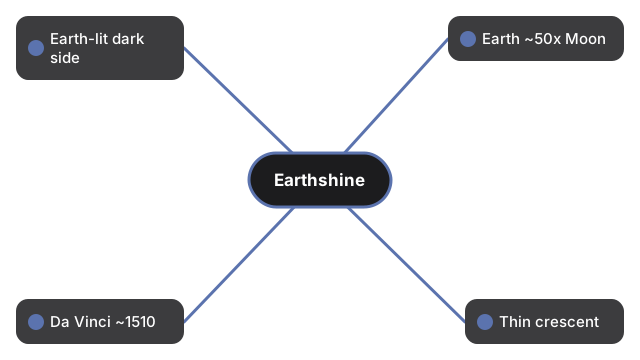
Published literacy: earthshine is sunlight reflected off Earth (mostly its clouds) onto the Moon night side; Leonardo da Vinci explained it around 1510; from the Moon, Earth shines about 50 times brighter than our full Moon (albedo ~0.30), and the glow is clearest at a thin crescent near new moon.
Drag to orbit and scroll or pinch to zoom. Slide the phase from crescent to half, toggle the earthshine, or pause the motion.
Earthshine 3D Explorer
Catch a slim crescent Moon just after sunset and look closely: you can usually see the entire round face of the Moon, glowing a soft ash-grey inside the bright crescent. That faint light is earthshine - sunlight that reflected off Earth first and then lit up the Moon night side. It has a lovely old name, the old Moon in the new Moon arms, and this explorer shows exactly where the glow comes from.
The Moon has no light of its own; the bright crescent is where the Sun shines directly. But the rest of the near side is not truly dark. Standing on that part of the Moon you would see a brilliant, nearly full Earth overhead - about 50 times brighter than our full Moon, because Earth is far larger and its clouds reflect roughly 30% of the sunlight that hits them (an albedo of about 0.30). That reflected earthlight gently illuminates the lunar night, and a little of it bounces back to your eye. Leonardo da Vinci was the first to explain this, around 1510 in his Codex Leicester; he guessed the reflection came from Earth oceans, but we now know clouds do most of it. Earthshine is easiest to see at a thin crescent a few days before or after new moon - after dusk in the west while waxing, before dawn in the east while waning - and is brightest in spring when snow and cloud raise Earth albedo.
- A crescent Moon lit directly by the Sun, with the night side glowing faintly
- A blue marker for Earth, the source of the reflected earthshine
- A phase slider from a thin crescent toward half, changing how much glow shows
- An earthshine toggle to compare with a truly dark night side
- Facts panel with the da Vinci story and the ~50x brightness figure
- Runs fully in the browser with the vendored three.js engine - no account, no upload
Stargazers learn what that ghostly full-Moon shape really is; students trace the light from Sun to Earth to Moon; teachers connect Earth albedo to how bright the glow appears.
| Figure | Value | Source note |
|---|---|---|
| What lights the dark side | sunlight reflected off Earth | Mostly clouds, not oceans |
| Earth from the Moon | ~50x brighter than our full Moon | Larger disk + ~0.30 albedo |
| First explained | ~1510, Leonardo da Vinci | Codex Leicester |
| Clearest | thin crescent, near new moon | Dusk (waxing) or dawn (waning) |
Everything renders on your device with WebGL. The 3D engine loads once (about 0.7 MB) and is cached; no scene data is sent to a server.
This is an educational visualization - the earthshine brightness is boosted so it is easy to see (it really takes three faint bounces), and the scene is not to scale.
For a step-by-step walkthrough, read the Earthshine 3D Explorer step-by-step guide. The Space 3D collection also includes Moon Phases 3D and Earth 3D Globe.
Frequently Asked Questions
What is earthshine?
It is the faint glow on the dark part of a crescent Moon, caused by sunlight reflecting off Earth and onto the lunar night side. It is also called the ashen light or the Da Vinci glow.
Why is it called the old Moon in the new Moon arms?
Because you see the full round shape of the Moon glowing faintly inside the bright crescent, as if the old full Moon were cradled by the new crescent.
Who first explained it?
Leonardo da Vinci, around 1510 in his Codex Leicester. He realized the glow was earthlight, though he thought oceans did the reflecting when it is mostly clouds.
When can I see it?
At a thin crescent, a few days before or after new moon. Look west after dusk while the Moon is waxing, or east before dawn while it is waning.
How bright is Earth from the Moon?
About 50 times brighter than our full Moon. Earth is a much larger disk in the lunar sky and reflects roughly 30% of the sunlight that hits it (an albedo near 0.30).
Is this scene to scale?
No. The earthshine is boosted so it is easy to see - in reality it is dim because the light takes three bounces from Sun to Earth to Moon to your eye. Sizes and distances are not to scale.