
In October 2019, the red supergiant Betelgeuse began dimming dramatically - by mid-February 2020 it had lost more than two-thirds of its brightness, the faintest it had been in nearly two centuries of records. Some astronomers wondered whether the star, which will eventually end its life in a supernova, might finally be exploding. Scrub the day slider below to follow the real month-by-month story, from the first eruption to the star's full recovery in April 2020.
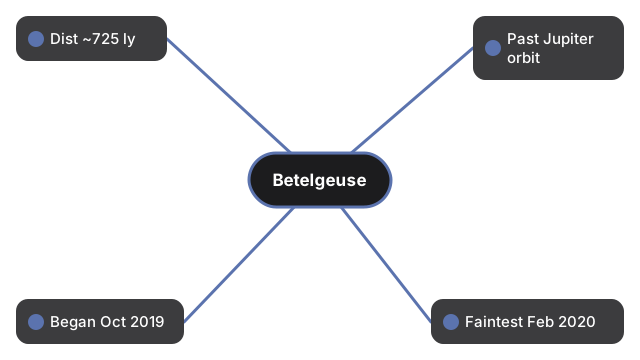
Published figures: dimming began October 2019, reached its faintest point (over two-thirds dimmer than normal) in mid-February 2020, and fully recovered by April 2020. Hubble observed the ejected gas moving outward at about 200,000 mph.
Drag to orbit and scroll or pinch to zoom. Scrub the Day slider, press Play, or change the speed.
Betelgeuse's Great Dimming 3D Explorer
Betelgeuse, the bright red supergiant marking Orion's shoulder, is one of the largest stars visible to the naked eye. It is so large that if it replaced the Sun at the center of our Solar System, its surface would reach past the orbit of Jupiter. Starting in October 2019, sky watchers noticed something odd: the star was fading. By mid-February 2020 it had lost more than two-thirds of its usual brightness - dim enough to notice without a telescope, and the faintest it had been in nearly two centuries of recorded observations. Because Betelgeuse is genuinely destined to end its life in a supernova someday, some astronomers seriously wondered whether this might be the beginning of that explosion.
NASA's Hubble Space Telescope had already been watching. In the fall of 2019, it caught a huge amount of hot, dense gas erupting from the star's surface and moving outward through its extended atmosphere at roughly 200,000 miles per hour. Researchers, led by Andrea Dupree of the Center for Astrophysics, pieced together what happened next: that gas cooled as it traveled outward, condensing into a vast cloud of dust more than a hundred million miles wide. The cloud blocked light from part of the star's surface, and that blockage - not an explosion - was the real cause of the Great Dimming. By April 2020, the dust had dispersed and Betelgeuse's brightness returned to normal, though the event left the star's outer layers measurably cooler and disrupted its usual 400-day brightness cycle for more than two years afterward.
- A Day slider (0-180) scrubbing through the real October 2019 to April 2020 timeline
- A dust cloud that grows and fades exactly in step with the real recorded brightness
- A built-in size comparison: a Sun-sized dot and Jupiter's orbit, both dwarfed by the star
- A live brightness readout and phase label as you scrub or press Play
- Runs fully in the browser with the vendored three.js engine - no account, no upload
Anyone who remembers "is Betelgeuse about to explode?" headlines gets the real month-by-month answer; students see exactly how a surface eruption can turn into a dust cloud that dims a star from tens of trillions of miles away.
| Figure | Value | Source note |
|---|---|---|
| Distance | about 725 light-years | NASA |
| Size comparison | surface would reach past Jupiter's orbit | If it replaced the Sun |
| Dimming began | October 2019 | Naked-eye visible by early 2020 |
| Faintest point | mid-February 2020 | Over two-thirds dimmer than normal |
| Ejected-gas speed | about 200,000 mph | Observed by Hubble |
| Cause | a dust cloud from a surface mass ejection | Not an imminent supernova |
| Recovered | April 2020 | Full brightness restored |
Everything renders on your device with WebGL. The 3D engine loads once (about 0.7 MB) and is cached; no scene data is sent to a server.
This is an educational visualization, not a stellar-atmosphere simulation - the star, the size-comparison markers, and the dust cloud's shape are all scaled for legibility, and the real 6-month event is heavily compressed into a short demo loop.
For a step-by-step walkthrough, read the Betelgeuse's Great Dimming 3D Explorer step-by-step guide. The Space 3D collection also includes Tabby's Star 3D Explorer and 'Oumuamua 3D Explorer, two more real cases where speculation and actual evidence diverged.
Frequently Asked Questions
What was Betelgeuse's Great Dimming?
A dramatic fading of the red supergiant Betelgeuse from October 2019 to April 2020, losing more than two-thirds of its brightness at its faintest.
Was Betelgeuse about to go supernova?
Some astronomers considered it, since Betelgeuse will eventually explode - but the star's full recovery by April 2020 pointed to a different, non-explosive cause.
What actually caused the dimming?
A giant surface eruption sent hot gas outward at about 200,000 mph. The gas cooled into a large dust cloud that blocked light from part of the star's surface.
How big is Betelgeuse?
So large that if it replaced the Sun, its surface would extend past Jupiter's orbit.
How far away is Betelgeuse?
About 725 light-years, meaning the event we watched in 2019-2020 actually happened around the year 1300.
Did the star fully recover?
Yes, by April 2020 - though the eruption left its outer layers measurably cooler and disrupted its normal 400-day brightness cycle for more than two years.
Is this scene to scale?
No. The star, the size-comparison markers, and the dust cloud are scaled for legibility, and the real 6-month event is compressed into a short demo loop.