
Explore the planar figure-8 three-body choreography - equal masses in a periodic orbit (Chenciner & Montgomery, 2000). SI literacy: G = 6.674×10⁻¹¹.
Published literacy: Newton G = 6.674×10⁻¹¹ m³ kg⁻¹ s⁻²; the figure-8 choreography is a rare periodic solution among chaotic three-body motions (2000).
Drag to orbit and scroll or pinch to zoom. Scrub speed, add a tiny IC kick to see sensitivity, or reset to the classic figure-8.
Three-Body Problem 3D Explorer
This browser explorer shows the three-body problem via the planar figure-8 choreography - three equal masses on a periodic orbit (Chenciner & Montgomery, 2000). SI literacy constant: G = 6.674×10⁻¹¹.
Scrub integration speed, add a tiny initial-condition kick to see how sensitive the dance is, or reset to the classic figure-8. Gravity Well 3D owns potential surfaces; Gravitational Slingshot 3D owns flyby assists - this page owns the three-body choreography sandbox.
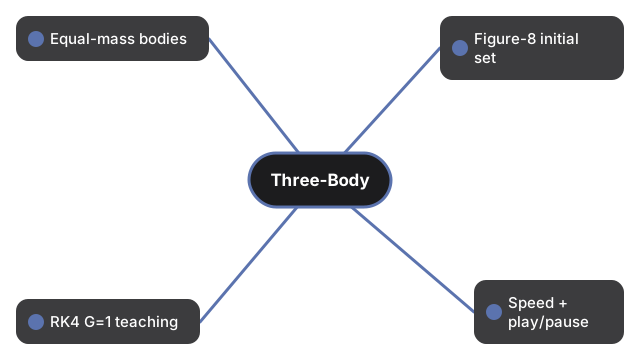
- Three equal-mass bodies with colored trails
- Figure-8 Chenciner-Montgomery initial conditions
- RK4 integrator in G=1 teaching units
- Speed scrubber and play/pause
- IC kick scrubber for sensitivity literacy
- Facts panel lists G = 6.674×10⁻¹¹ and the 2000 figure-8 solution
- Distinct from gravity-well and gravitational-slingshot
- Runs fully in the browser with the vendored three.js engine - no account, no upload
Students see a rare periodic three-body orbit; teachers contrast choreography with chaos; curious readers connect Newton\'s G to a one-screen sandbox.
| Figure | Value | Source note |
|---|---|---|
| Newton G (SI) | 6.674×10⁻¹¹ m³ kg⁻¹ s⁻² | Standard gravitational constant literacy |
| Figure-8 solution | 2000 | Chenciner & Montgomery choreography |
| Demo units | G=1, m=1 | Normalized teaching integrator |
Everything renders on your device with WebGL. The 3D engine loads once (about 0.7 MB) and is cached; no scene data is sent to a server.
This is an educational three-body sandbox - not a general N-body ephemeris.
For a step-by-step walkthrough, read the Three-Body Problem 3D Explorer step-by-step guide. The Space 3D collection also includes Gravity Well 3D and Gravitational Slingshot 3D.
Frequently Asked Questions
What does the Three-Body Problem 3D Explorer show?
Three equal masses on the planar figure-8 choreography orbit, with trails, speed control, and an optional IC kick for sensitivity literacy.
What is the figure-8 solution?
A rare periodic orbit where three equal masses chase each other on a figure-8 path - published as a choreography solution (Moore; Chenciner & Montgomery, 2000).
Why mention G = 6.674×10⁻¹¹ if the demo uses G=1?
The SI constant is the literacy figure. The integrator uses G=1 normalized units so the figure-8 initial conditions stay readable on screen.
How is this different from Gravity Well 3D?
Gravity Well 3D shows a potential surface. This page integrates three bodies on the figure-8 choreography.
How is this different from Gravitational Slingshot 3D?
Gravitational Slingshot 3D teaches a planetary flyby assist. This page teaches the classical three-body choreography sandbox.
Is this a general N-body simulator?
No. It is an educational three-body sandbox focused on the figure-8 solution - not a general N-body ephemeris.