
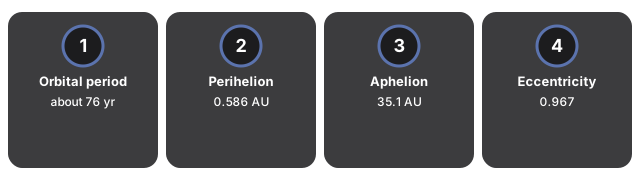
Watch a Halley-like comet on an eccentric ellipse - scrub perihelion to aphelion, toggle ion and dust tails, and see both point anti-sunward while the panel lists P about 76 yr, q 0.586 AU, Q 35.1 AU, and e 0.967.
Play orbit walks the nucleus around the compressed ellipse; pause and scrub to park near perihelion where tails stretch, or near aphelion where they shrink.
Ion (blue) and dust (yellow) tails point roughly away from the Sun. On-screen distances are compressed so both ends fit one view - the table below keeps the published Halley figures. This is an educational geometry visualization, not an N-body or outgassing simulation.
Comet Orbit 3D Explorer
This browser explorer places a Halley-like comet on a strongly eccentric ellipse so you can follow how its ion and dust tails swing anti-sunward as the nucleus travels between perihelion and aphelion.
Drag to orbit the view, scroll or pinch to zoom, and press Play orbit. Toggle Ion tail and Dust tail independently, and scrub Orbit progress to park the nucleus anywhere on the path.
The facts panel lists the orbital period, perihelion, aphelion, and eccentricity from standard Halley references - the same values collected in the table below - plus an approximate heliocentric distance readout on the compressed orbit.
- Eccentric ellipse with nucleus scrub / play
- Anti-sunward ion (blue) and dust (yellow) tails
- Independent ion / dust visibility toggles
- Published Halley figures in the facts panel
- Compressed orbit so perihelion and aphelion fit one screen
- Runs fully in the browser with the vendored three.js engine - no account, no upload
Teachers use it to show why comet tails point away from the Sun, students scrub to perihelion to see tails stretch, and curious readers compare the extreme eccentricity to nearly circular planet orbits.
| Quantity | Value | Source |
|---|---|---|
| Orbital period | about 76 yr | Halley ephemeris literature |
| Perihelion | 0.586 AU | Published Halley elements |
| Aphelion | 35.1 AU | Published Halley elements |
| Eccentricity | 0.967 | Published Halley elements |
Everything renders on your device with WebGL. The 3D engine loads once (about 0.7 MB) and is cached; no scene data is sent to a server.
The scene is an educational visualization of eccentric geometry and anti-sunward tails - orbit distances are compressed for one-screen fit (not true 35 AU scale on screen), and it is not an N-body model, outgassing chemistry sim, or live ephemeris for Halley's next return.
For a step-by-step walkthrough, read the Comet Orbit 3D Explorer guide. The Space 3D collection also includes a Solar System 3D Explorer for the planets and a Asteroid Belt 3D Explorer for Kirkwood gaps in the main belt.
Frequently Asked Questions
What does Comet Orbit 3D Explorer show?
A Halley-like eccentric comet orbit with perihelion 0.586 AU and aphelion 35.1 AU in the facts table, plus ion and dust tails that point roughly anti-sunward.
How is this different from Solar System 3D Explorer?
Solar System 3D Explorer shows the Sun and planets on near-circular paths. Comet Orbit 3D Explorer focuses on extreme eccentricity and anti-sunward tails - geometry the planet-only scene does not teach.
Why do both tails point away from the Sun?
Radiation pressure and the solar wind push material roughly anti-sunward. The page uses blue for the ion tail and yellow for the dust tail so you can toggle each independently.
Is the on-screen orbit to real scale?
No. Distances are compressed so perihelion and aphelion fit one view. The panel table keeps the published Halley figures (P about 76 yr, q 0.586 AU, Q 35.1 AU, e 0.967).
Is this an N-body or outgassing simulation?
No. The scene is an educational geometry visualization. It does not integrate gravity, predict return dates, or model coma chemistry.
What are typical Halley orbital elements?
Period about 76 years, perihelion 0.586 AU, aphelion 35.1 AU, and eccentricity 0.967 - the values listed in the facts table.