
Some planetary rings are impossibly thin and sharp-edged, and for a while that was a puzzle: left to themselves, ring particles should shear and spread into a broad haze. The answer is shepherd moons - small satellites flanking a ring whose gravity herds the particles back into line. The inner moon nudges strays outward, the outer moon tugs them inward, and the ring stays a crisp ribbon. Press play, then toggle the shepherds off and watch the ring drift apart.
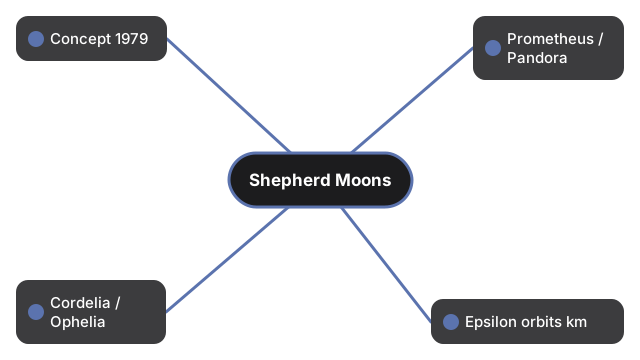
Published literacy: shepherd moons confine narrow rings by gravitational nudges - proposed in 1979 by Goldreich and Tremaine and confirmed by Voyager. Saturn thin F ring is flanked by Prometheus and Pandora (1980), while Uranus sharp epsilon ring is penned by Cordelia at 49,752 km and Ophelia at 53,764 km (1986).
Drag to orbit and scroll or pinch to zoom. Change the speed, toggle the shepherds on or off, or pause the motion.
Shepherd Moons 3D Explorer
Planetary rings ought to be untidy. Because particles closer to a planet orbit faster than those farther out, any narrow band of debris should smear itself into a broad, fuzzy sheet within a few orbits. Yet some rings are startlingly thin and sharp. The explanation, worked out in 1979 by Peter Goldreich and Scott Tremaine, is the shepherd moon: a small satellite orbiting just inside or just outside a ring, whose gravity keeps the particles from wandering. This explorer draws a ring with a shepherd on each side and lets you switch their herding on and off.
The trick is a give-and-take of orbital energy. A particle that drifts inward speeds up and catches the inner moon, whose gravity tugs it forward and lifts it back out; a particle that drifts outward slows down and lets the outer moon catch up, and that pull drags it back in. Between the two moons the herd is penned into a crisp ribbon. Voyager 1 found Prometheus and Pandora straddling Saturn thin F ring in 1980, and Voyager 2 found Cordelia and Ophelia guarding Uranus epsilon ring in 1986. The Uranus pair is the clean textbook case; the F ring turned out to be far more chaotic, dominated by Prometheus alone, which also kicks up the ring famous kinks and streamers.
- A ringed planet with a narrow band of particles and a shepherd moon on each side
- A toggle that turns the shepherding on and off
- With shepherds on, a thin crisp ringlet held between the two moons
- With shepherds off, the band shearing and spreading into a broad disc
- A speed slider and the real Prometheus, Pandora, Cordelia and Ophelia figures
- Runs fully in the browser with the vendored three.js engine - no account, no upload
Students see why thin rings need help to stay thin; teachers link the herding to Voyager discoveries; the curious watch a ring fall apart and snap back at the flick of a switch.
| Figure | Value | Source note |
|---|---|---|
| Concept proposed | 1979 | Goldreich and Tremaine |
| Saturn F ring shepherds | Prometheus, Pandora | Voyager 1, 1980 |
| Uranus epsilon shepherds | Cordelia, Ophelia | Voyager 2, 1986 |
| Epsilon shepherd orbits | 49,752 and 53,764 km | Inner and outer |
Everything renders on your device with WebGL. The 3D engine loads once (about 0.7 MB) and is cached; no scene data is sent to a server.
This is an educational visualization - the confinement is illustrative rather than a gravity solver, sizes and distances are not to scale, and the motion is sped up.
For a step-by-step walkthrough, read the Shepherd Moons 3D Explorer step-by-step guide. The Space 3D collection also includes Saturn Rings 3D and Planetary Rings Comparison 3D.
Frequently Asked Questions
What is a shepherd moon?
A small moon orbiting just inside or outside a ring whose gravity herds the ring particles, keeping a narrow ring thin and sharp-edged or clearing a gap.
How do two shepherds confine a ring?
The inner moon orbits faster and tugs inward-drifting particles back out; the outer moon orbits slower and pulls outward-drifting particles back in. Between them the particles stay penned.
Which moons shepherd Saturn F ring?
Prometheus on the inside and Pandora on the outside, found by Voyager 1 in 1980. In reality the F ring is chaotic and dominated by Prometheus, which also raises its kinks and streamers.
Which moons shepherd Uranus epsilon ring?
Cordelia at about 49,752 km on the inside and Ophelia at about 53,764 km on the outside, found by Voyager 2 in 1986. This is the clean textbook example of shepherding.
Who came up with the idea?
Peter Goldreich and Scott Tremaine proposed shepherd moons in 1979 to explain why Uranus rings were so narrow, before the moons themselves had been seen.
Is this scene to scale?
No. The confinement is illustrative rather than a gravity solver, the sizes and distances are not to scale, and the motion is sped up so the spreading and herding show in seconds.