
See where the Sun sits among the labeled spiral arms in a top-down 3D view of our galaxy.
Milky Way Map 3D Explorer
FreetoolOnline editorial teamExplore a top-down map of our Milky Way - labeled Sagittarius, Orion (Local), and Perseus arms with the Sun about 26,000 light-years from the center on a disk about 100,000 light-years across.
Drag to orbit the view, scroll or pinch to zoom, and press Play spin to turn the disk slowly so the arm labels stay readable. Highlight Sun, Sagittarius, Orion, Perseus, or Center to fill the facts panel.
- Top-down Milky Way particle disk with warm core
- Labeled teaching arms: Sagittarius, Orion (Local), Perseus
- Yellow Sun marker on an orbit ring at ~26,000 ly
- Galactic center fleck toward the core
- Play spin / Pause spin for a slow educational beat
- Runs fully in the browser with the vendored three.js engine - no account, no upload
Teachers use it to place the Sun in our galaxy, and students jump arm buttons to read structure names.
| Quantity | Value | Source |
|---|---|---|
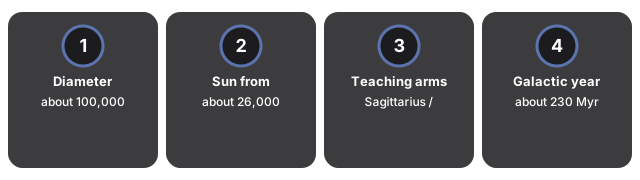
| Diameter | about 100,000 ly | Standard galactic summaries |
| Sun from center | about 26,000 ly | Standard galactic summaries |
| Teaching arms | Sagittarius / Orion (Local) / Perseus | Common classroom labels |
| Galactic year | about 230 Myr (range 225-250) | Literature order of magnitude |
Rendering happens on your device with WebGL; the 3D engine loads once (about 0.7 MB) and is cached.
The scene is an educational visualization - arm paths are parametric art sized to published diameters, not a Gaia catalog or N-body disk simulation. For session fit, the three-step walkthrough, and the limits, see the Milky Way Map 3D Explorer guide. The Space 3D collection also includes a Galaxy 3D Simulator for a generic unlabeled spiral and a Solar System 3D Explorer for our planets.
Depth: how this labeled map differs from a generic spiral
Every structure on this map is named, not just suggested. The Galaxy 3D Simulator regenerates an unlabeled spiral for mood and motion, so there is nothing to jump to; here the focus buttons snap the facts panel to a specific arm, the Sun, or the center, and the labels stay upright as the disk turns - pacing tuned for a classroom rather than a screensaver. Reach for this labeled map when you need to place the Sun inside a named structure, and use the Galaxy 3D Simulator when an unlabeled spiral is all the scene calls for.
Frequently Asked Questions
What does Milky Way Map 3D Explorer show?
A top-down teaching map of the Milky Way with Sagittarius, Orion (Local), and Perseus arm markers, a Sun fleck about 26,000 ly from the center, and a diameter about 100,000 ly in the facts table.
How is this different from Galaxy 3D Simulator?
Galaxy 3D Simulator builds a generic unlabeled spiral. Milky Way Map 3D Explorer is our galaxy - named arms plus the Sun's place in the disk.
Where is the Sun?
About 26,000 light-years from the galactic center, shown as a yellow fleck on the Orion (Local) Arm with a faint orbit ring.
What is a galactic year?
The time for the Sun to orbit the galactic center once - about 230 million years here, with a common published range of 225-250 Myr.
Are the arms exact survey maps?
No. Arm labels are classroom teaching markers on parametric spiral art sized to published diameters - not a Gaia survey catalog.
Is this an N-body simulation?
No. The scene is an educational geometry visualization. It does not integrate gravity or evolve star formation.