
Explore a teaching celestial sphere with embedded bright-star RA/Dec and V magnitudes, classic asterism sticks (Orion, Ursa Major, Crux, Summer Triangle), and the IAU count of 88 official constellations.
Star positions use embedded RA hours, Dec degrees, and V magnitudes - numeric teaching data, not a sky survey texture.
Distinct from Ecliptic Zodiac 3D Explorer: that page teaches the Sun's path and thirteen ecliptic constellations; this page is a general celestial-sphere map with classic asterisms and the IAU 88 count.
Constellation Sphere 3D Explorer
Constellation Sphere 3D Explorer places bright stars on a spinnable celestial sphere so the familiar stick figures and the official sky regions stop blurring together. Tap an asterism to light its sticks, then read that star's catalog-style figure straight from the panel.
Drag to orbit, scroll or pinch to zoom, tap Orion / Ursa Major / Crux / Summer Triangle to highlight sticks, toggle the equatorial teaching grid, and use Mag limit to show brighter-only samples. Click a star for its catalog-style figure - Sirius reads about -1.46 V in the panel.
- Celestial sphere shell with equatorial teaching grid toggle
- IAU constellation count: 88
- Embedded bright-star RA hours, Dec degrees, V mag
- Orion, Ursa Major, Crux, and Summer Triangle asterism focus buttons
- Runs fully in the browser with the vendored three.js engine - no account, no upload
Teachers use Constellation Sphere 3D Explorer to show how RA/Dec place stars on a sphere, students connect stick figures to named bright stars, and curious readers separate asterisms from the official 88 IAU regions.
| Quantity | Value | Source |
|---|---|---|
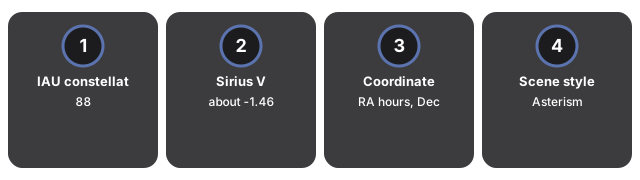
| IAU constellations | 88 | IAU constellation delineation (1922 list / 1930 boundaries era) |
| Sirius V magnitude | about -1.46 | Standard bright-star catalog values |
| Coordinate frame | RA hours, Dec degrees | Equatorial coordinates on the celestial sphere |
| Scene style | Asterism sticks + sample stars | Educational embedding - not full boundaries |
Everything renders on your device with WebGL. The 3D engine loads once (about 0.7 MB) and is cached; no scene data is sent to a server.
Constellation Sphere 3D Explorer is not a full IAU boundary polygon atlas, not an all-sky survey texture or photometric catalog dump, and not a planetarium with live time or telescope control. For the Sun path and 13 ecliptic constellations, open Ecliptic Zodiac 3D Explorer; for apparent versus absolute brightness, open Stellar Magnitude 3D Explorer.
For a step-by-step walkthrough, read the Constellation Sphere 3D Explorer step-by-step guide. The Space 3D collection also includes those sibling explorers.
Frequently Asked Questions
What does Constellation Sphere 3D Explorer show?
A teaching celestial sphere with bright-star RA/Dec and V magnitudes, classic asterism sticks, and the IAU figure of 88 official constellations.
Is this the same as Ecliptic Zodiac 3D Explorer?
No. Ecliptic Zodiac focuses on the Sun's yearly path and thirteen ecliptic constellations including Ophiuchus. Constellation Sphere is a general sky map with asterisms and the full IAU count literacy.
What does RA and Dec mean here?
Right ascension (hours) and declination (degrees) place a star on the celestial sphere in the equatorial frame. The scene embeds those numbers for a bright-star sample.
Does the page draw all 88 constellation boundaries?
No. It states the IAU count of 88 and draws traditional asterism sticks for a few famous figures. Full boundary polygons are a different dataset and would be a different product.
Are the faint background stars a real survey?
No. Named bright stars use embedded catalog-style figures; the faint field is procedural fill so the sphere feels populated without shipping a survey dump.
Does any data leave my device?
No uploads and no login. The vendored three.js engine renders on your device; status and facts stay in the browser.