
TRAPPIST-1, a small, cool star just 40 light-years away, turned out to have seven planets - all roughly Earth-sized, all packed into a region smaller than Mercury's orbit around our Sun. What makes the system truly remarkable is how the planets move: each neighboring pair locks into a precise ratio of orbital periods, forming a rare chain of resonances that spans all seven worlds. Press play to watch them orbit at their real relative speeds, then toggle the habitable-zone band to see where liquid water could exist.
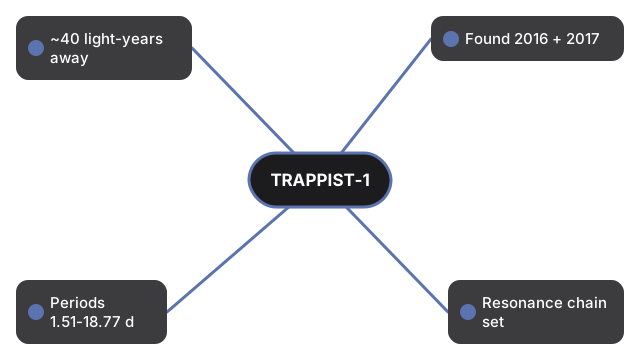
Published figures: orbital periods run from 1.51 days (b) to 18.77 days (h); adjacent-pair resonances are 8:5, 5:3, 3:2, 3:2, 4:3, and 3:2. Up to four planets (d, e, f, g) sit where surface liquid water could be possible.
Drag to orbit and scroll or pinch to zoom. Press Play, change the speed, or toggle the habitable-zone band.
TRAPPIST-1 3D Explorer
In May 2016, a small robotic telescope in Chile called TRAPPIST - The Transiting Planets and Planetesimals Small Telescope - spotted two or three planets crossing in front of a dim, cool star. Follow-up observations with NASA's Spitzer Space Telescope and ground-based facilities kept finding more. By the time NASA announced the full result on 22 February 2017, the count stood at seven: the largest batch of Earth-sized planets ever found orbiting a single star.
What makes TRAPPIST-1 more than just a numbers record is how its planets move together. Each pair of neighboring worlds locks into a precise ratio of orbital periods - 8:5, 5:3, 3:2, 3:2, 4:3, and 3:2 going outward - forming a rare resonant chain that links all seven planets to each other's gravity. The system is astonishingly compact: at their closest approach, the two innermost planets pass within roughly twice the distance between the Earth and the Moon. Up to four of the seven worlds - d, e, f, and g - orbit at distances where surface temperatures could allow liquid water, more potentially habitable planets than any other known system. And the star itself holds one more surprise: despite genuinely fusing hydrogen like the Sun, it is barely larger than Jupiter - the same kind of size story told on this site's Brown Dwarf 3D Explorer.
- All seven real planets, each on its own real relative orbit and period
- A Habitable-zone band toggle over the planets it actually covers
- A per-planet table of real distances, periods, and habitable-zone status
- A speed slider and Play/Pause over the whole system
- Runs fully in the browser with the vendored three.js engine - no account, no upload
Students see exactly how a resonant chain looks in motion; anyone who has heard "seven Earth-like planets" gets the real distances, periods, and habitable-zone nuance behind the headline.
| Figure | Value | Source note |
|---|---|---|
| Distance from Earth | about 40 light-years | Constellation Aquarius |
| Discovery | May 2016 + February 2017 | TRAPPIST-South, then Spitzer |
| Orbital periods | 1.51 to 18.77 days | All seven planets |
| Resonance chain | 8:5, 5:3, 3:2, 3:2, 4:3, 3:2 | Six neighboring-pair ratios |
| Likely habitable-zone planets | d, e, f, g | Where liquid water could exist |
| Host star size | Jupiter-like | Despite genuine hydrogen fusion |
Everything renders on your device with WebGL. The 3D engine loads once (about 0.7 MB) and is cached; no scene data is sent to a server.
This is an educational visualization, not an atmospheric or climate model - the star and planets are enlarged for visibility, and orbital motion is heavily sped up. All seven planets are likely tidally locked, each with a permanent day side and night side, which this scene does not attempt to render.
For a step-by-step walkthrough, read the TRAPPIST-1 3D Explorer step-by-step guide. The Space 3D collection also includes Brown Dwarf 3D Explorer for more on why a star's radius can be deceptively small.
Frequently Asked Questions
How many planets does TRAPPIST-1 have?
Seven confirmed planets, all roughly Earth-sized, discovered in 2016 and 2017.
What is the resonance chain?
Each pair of neighboring planets orbits in a precise period ratio - 8:5, 5:3, 3:2, 3:2, 4:3, and 3:2 going outward - linking all seven planets' gravity together.
How many TRAPPIST-1 planets could be habitable?
Up to four - d, e, f, and g - orbit at distances where surface temperatures could allow liquid water. The original 2017 announcement highlighted three (e, f, g) as firmly in the habitable zone.
How far away is TRAPPIST-1?
About 40 light-years, in the constellation Aquarius.
Is the star itself like the Sun?
No. It is an ultracool dwarf star, only about 8% the mass of the Sun, and despite genuinely fusing hydrogen, it is only about the size of Jupiter.
How compact is the system?
Extremely. All seven orbits fit inside a region smaller than Mercury's orbit around the Sun, and the two innermost planets pass within roughly twice the Earth-Moon distance at their closest approach.
Is this scene to scale?
No. The star and planets are enlarged for visibility, and orbital motion is heavily sped up compared to the real system.