
Every month has a New Moon, and Venus has phases too - but you need a telescope to see them, and what they show is profound. As Venus laps the Sun on an orbit inside our own, we catch its sunlit face at different angles, so it runs a full set of phases from thin crescent to round full. The clincher is that the phase tracks its distance: fat and crescent when it is near, small and gibbous when it is far across the Sun. In 1610 Galileo saw that full set - impossible if the Sun circled Earth - and it proved Venus orbits the Sun. Press play and watch the preview disc change.
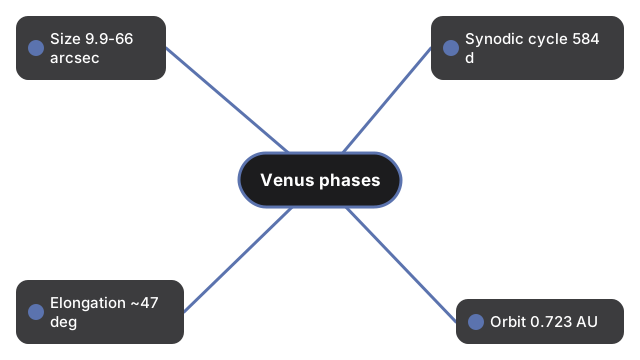
Published literacy: Venus shows a full run of phases and its apparent diameter swings from about 9.9 arcsec when full and far to about 66 arcsec when a near crescent. The phase cycle repeats every 584 days, and Venus never strays more than about 47 degrees from the Sun. A full or gibbous Venus is impossible in the old Earth-centred model, which is why Galileo 1610 observation was decisive.
Drag to orbit and scroll or pinch to zoom. Change the speed, hide the phase preview disc, or pause the motion.
Venus Phases (Galileo) 3D Explorer
Venus is the brilliant morning and evening star, and through a telescope it does something the naked eye never reveals: it shows phases, just like the Moon. This explorer places the Sun at the centre, sends Venus around an inner orbit and Earth around an outer one, and shows the sunlit face we would see from Earth as a small preview disc. Because Venus laps the Sun faster than we do, we watch it swing from a thin crescent to a round full disc and back, on a cycle of about 584 days.
The detail that changed history is the link between phase and size. When Venus is a fat crescent it is also large, because it is on our side of the Sun and close; when it is gibbous or full it is small, because it is across the Sun and far away. In the old Earth-centred model of Ptolemy, Venus was stuck on a small circle between Earth and the Sun and could only ever look like a thin crescent - a full Venus was flatly impossible. When Galileo Galilei turned his telescope on the planet in 1610 and saw the complete set of phases, he had direct proof that Venus circles the Sun, not the Earth. The same evidence fit the Copernican and Tychonic systems and demolished the strict Ptolemaic one.
- The Sun at the centre with Venus on an inner orbit and Earth on an outer one
- A live preview disc showing Venus phase and changing apparent size
- A running readout of the phase name, percent lit, apparent size, and distance
- The link between crescent-and-near versus gibbous-and-far made visible
- A speed slider and pause to step through the 584-day cycle
- Runs fully in the browser with the vendored three.js engine - no account, no upload
Students meet the observation that settled a centuries-old debate; teachers pair the phase with the distance to show why it beats the geocentric model; sky watchers picture what their own telescope reveals.
| Figure | Value | Source note |
|---|---|---|
| Apparent diameter | 9.9 to 66 arcsec | Full-far to new-near |
| Phase cycle (synodic) | 584 days | Relative to Earth |
| Greatest elongation | about 47 degrees | Max angle from the Sun |
| Orbit radius | 0.723 AU | Inside Earth orbit |
Everything renders on your device with WebGL. The 3D engine loads once (about 0.7 MB) and is cached; no scene data is sent to a server.
This is an educational visualization - orbit sizes and the planet are compressed to fit the frame and the motion is sped up; the preview disc is an illustrative shape though its lit fraction is exact from the geometry. It is not to scale.
For a step-by-step walkthrough, read the Venus Phases (Galileo) 3D Explorer step-by-step guide. The Space 3D collection also includes Moon Phases 3D and Exoplanet Transit 3D.
Frequently Asked Questions
Why does Venus have phases?
Because we see its sunlit half from changing angles as it orbits the Sun inside Earth orbit. That gives a full set of phases from crescent to full, just like the Moon.
How did the phases prove Venus orbits the Sun?
In the old Earth-centred model Venus stayed between Earth and the Sun and could only look like a thin crescent. A full or gibbous Venus is impossible there, so seeing one proves it circles the Sun.
Why does Venus change size?
Its distance from Earth changes a lot. Near inferior conjunction it is close and looks large (up to about 66 arcsec); across the Sun it is far and small (about 9.9 arcsec).
When is Venus brightest?
Around a fat crescent, not full. Being close makes the crescent large enough that its lit area, though only partly lit, outshines the smaller full disc.
How long is the phase cycle?
About 584 days, the synodic period of Venus. That is how long it takes Venus to return to the same phase as seen from the moving Earth.
Is this scene to scale?
No. Orbit sizes and the planet are compressed to fit and the motion is sped up. The preview disc is an illustrative shape, though its lit fraction is computed exactly from the geometry.