
A young star is not born alone - it forms inside a flattened, spinning disk of gas and dust. In 2014 the ALMA telescope array imaged one of these protoplanetary disks around HL Tau in unprecedented detail, revealing concentric bright rings separated by dark gaps. This explorer places the real ALMA-measured ring and gap distances around a model star. Press play to watch the disk turn, and toggle the gaps to see where astronomers think young planets are clearing their orbits.
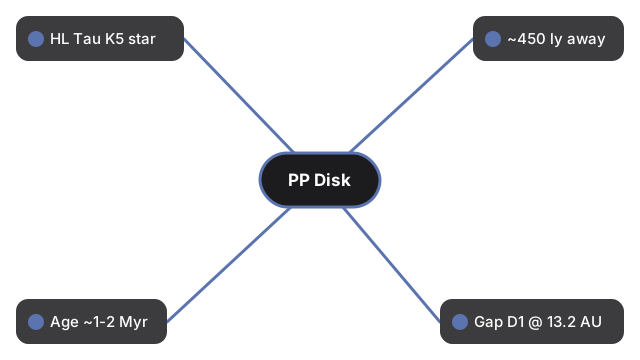
Published figures: the innermost gap (D1) sits 13.2 AU from HL Tau and is 46% dimmer than its neighboring ring; the faintest-contrast gap (D5) sits 64.2 AU out and is only 15% dimmer. The outermost measured ring (B7) sits about 97 AU from the star.
Drag to orbit and scroll or pinch to zoom. Change the speed, hide the gap markers, or pause the motion.
Protoplanetary Disk 3D Explorer
Every star is born inside a flattened, spinning disk of leftover gas and dust, and for decades astronomers could only guess at its inner structure. That changed in 2014, when the Atacama Large Millimeter/submillimeter Array (ALMA) turned its longest baselines on HL Tau, a Sun-like star only about 1 to 2 million years old, 450 light-years away in Taurus. The resulting image showed something nobody had resolved before: a neat pattern of concentric bright rings separated by dark gaps, at precise, measured distances from the star. This explorer places those real distances around a model disk so you can see the pattern for yourself.
The leading interpretation is that each gap marks where an unseen young planet is orbiting and sweeping up or scattering the dust around it, clearing a lane the way a snowplow clears a road. The evidence is indirect but consistent: the dark rings are not completely empty, their measured brightness contrast varies from gap to gap, and several of the gaps sit close to simple orbital-period ratios with each other - the kind of pattern gravity leaves behind. No telescope has yet directly imaged a planet sitting inside one of HL Tau's gaps, so this remains the leading explanation rather than a confirmed detection. The scene's Gaps toggle marks each measured gap with a guide ring and a small orange marker at the interpreted clearing site.
- A model star surrounded by a disk of dust particles colored by distance
- Bright rings and dark gaps placed at the real ALMA-measured radii
- A Gaps toggle that marks the seven measured gaps and their interpreted clearing sites
- A speed slider and Play and Pause control over the disk's slow turning
- Runs fully in the browser with the vendored three.js engine - no account, no upload
Students see what "planet formation in progress" actually looks like; teachers point to a single well-measured system instead of an artist's impression; anyone who has seen the famous ALMA picture of HL Tau can find out what its rings are measured to mean.
| Figure | Value | Source note |
|---|---|---|
| Star | HL Tau, spectral type K5 | ALMA Partnership 2015 |
| Distance | about 450 light-years | Taurus star-forming region |
| Age | about 1 to 2 million years | Taurus star-forming region age |
| Innermost gap (D1) | 13.2 AU, 46% dimmer than its ring | ALMA 2014 Long Baseline Campaign |
| Outermost measured ring (B7) | about 97 AU | ALMA Partnership 2015, Table 2 |
Everything renders on your device with WebGL. The 3D engine loads once (about 0.7 MB) and is cached; no scene data is sent to a server.
This is an educational visualization, not a gravity or dust-transport simulation - the ring and gap distances are the real ALMA measurements, but brightness, particle motion, and orbit speed are illustrative and heavily sped up; real orbits at these distances take decades to centuries, and the disk is shown face-on even though the true system is tilted about 46 degrees to our line of sight.
For a step-by-step walkthrough, read the Protoplanetary Disk 3D Explorer step-by-step guide. The Space 3D collection also includes Kirkwood Gaps 3D and Asteroid Belt 3D, which show gaps carved by gravity closer to home.
Frequently Asked Questions
What is a protoplanetary disk?
A flattened, spinning disk of gas and dust left over from star formation. Planets are thought to build up inside it from colliding dust grains and pebbles.
What did ALMA see around HL Tau?
In 2014 ALMA imaged concentric bright rings separated by dark gaps at precise, measured distances from the star - the sharpest picture yet taken of a young disk's structure.
What causes the gaps?
The leading interpretation is that unseen young planets are orbiting inside each gap and clearing dust from their path. No planet has actually been directly imaged inside an HL Tau gap, so this stays the leading explanation rather than a confirmed detection.
How far is the innermost gap from the star?
The innermost measured gap, D1, sits 13.2 AU from HL Tau and is about 46% dimmer than its neighboring bright ring - the largest brightness contrast measured in the disk.
How big is the whole disk?
The outermost ring with a measured radius, B7, sits about 97 AU from the star - roughly twice the distance from the Sun to Pluto.
How old and how far away is HL Tau?
HL Tau is about 1 to 2 million years old and lies about 450 light-years away in the constellation Taurus.
Is this scene to scale?
The ring and gap distances are the real ALMA-measured figures, but the disk is shown face-on for clarity, and the brightness, particle motion, and turning speed are illustrative and heavily sped up, not a physical simulation.