
Explore spacetime curvature as a teaching grid: mass bends geodesics, with literacy r_s = 2GM/c^2 (Sun ~2.95 km, Earth ~8.87 mm).
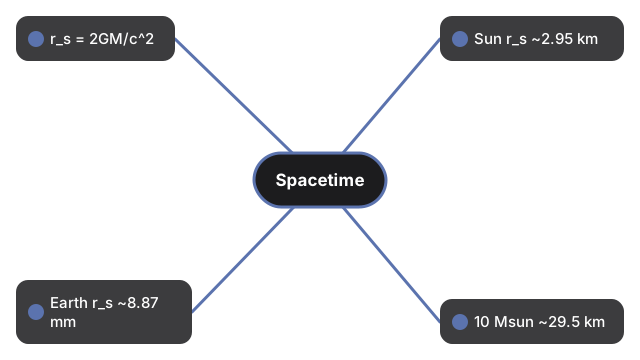
Published literacy: r_s = 2GM/c^2, Sun ~2.95 km, Earth ~8.87 mm, 10 Msun black hole ~29.5 km. The on-screen ring is exaggerated for teaching.
Drag to orbit and scroll or pinch to zoom. Switch Earth / Sun / 10 Msun BH, or toggle geodesics and the r_s ring.
Spacetime Curvature 3D Explorer
freetoolonline.com Editorial TeamThis browser explorer shows spacetime curvature as a teaching grid - mass bends nearby geodesics, with literacy r_s = 2GM/c^2 (Sun ~2.95 km, Earth ~8.87 mm).
Gravity Well 3D owns escape-velocity embedding wells. Light Cone 3D owns flat Minkowski causal regions. This page owns curved-grid geodesic intuition.
- Deformed spacetime grid that deepens with selected mass
- Earth / Sun / 10 Msun BH body presets
- Teal geodesic paths that bend toward the mass
- Exaggerated orange r_s teaching ring
- Facts panel lists 2GM/c^2, 2.95 km, 8.87 mm, and 29.5 km
- Distinct from gravity-well and light-cone
- Runs fully in the browser with the vendored three.js engine - no account, no upload
Students see why heavier bodies deepen the grid; teachers contrast flat light-cone diagrams with curved geodesics; curious readers connect r_s = 2GM/c^2 to the Sun's ~2.95 km figure.
| Figure | Value | Source note |
|---|---|---|
| r_s formula | 2GM/c^2 | Schwarzschild radius |
| Sun r_s | ~2.95 km | Published literacy |
| Earth r_s | ~8.87 mm | Published literacy |
| 10 Msun BH r_s | ~29.5 km | 10 x solar teaching scale |
Walking the controls, preset by preset
Five moves cover the scene. Run them in order and the grid depth, the geodesics, and the r_s ring each land on their own.
- Open the explorer and wait for the curved grid and the teal geodesics to paint.
- Read the facts panel: r_s = 2GM/c^2, Sun ~2.95 km, Earth ~8.87 mm.
- Press Earth, then Sun, then 10 Msun BH to compare how far the grid deepens.
- Press Hide geodesics and Hide r_s ring to strip the scene back to the grid alone.
- Press Fullscreen for a projector, then compare with Gravity Well 3D for escape velocities or Light Cone 3D for flat causal regions.
How this explorer compares with a textbook or a paid app
A static textbook diagram cannot be re-posed, and a paid app usually wants an install and an account. This page trades breadth for a curved grid you can push a mass through in seconds.
| Aspect | Spacetime Curvature 3D Explorer | Typical alternative |
|---|---|---|
| Install size | 0 MB - runs in the browser | Textbook or paid app varies |
| Price | USD 0 | Often paid or account-gated |
| Key figures shown | Sun r_s ~2.95 km; light bends 1.75 arcsec at the solar limb | Static diagram or text only |
Where the schematic stops
Everything renders on your device with WebGL. The 3D engine loads once (about 0.7 MB) and is cached; no scene data is sent to a server.
This is an educational curved-grid schematic - not a Schwarzschild metric solver. The r_s ring is exaggerated for one-screen teaching.
When you need session fit and limits, see when to use Spacetime Curvature 3D Explorer. The Space 3D collection also includes Gravity Well 3D and Light Cone 3D.
Frequently Asked Questions
What does the Spacetime Curvature 3D Explorer show?
A teaching grid that deepens near mass, teal geodesics that bend inward, and an exaggerated r_s ring. Literacy figures include r_s = 2GM/c^2, Sun ~2.95 km, and Earth ~8.87 mm.
How is this different from Gravity Well 3D?
Gravity Well 3D focuses on escape-velocity wells. This page focuses on curved-grid geodesic intuition and Schwarzschild-radius literacy.
How is this different from Light Cone 3D?
Light Cone 3D teaches flat Minkowski past/future/elsewhere regions. This page teaches how mass curves the nearby path grid.
Is the orange ring the real r_s size?
No. The ring is exaggerated so it is visible on one screen. Real Sun r_s is only about 2.95 km.
Is this a Schwarzschild metric solver?
No. It is an educational curved-grid schematic - not a full GR geodesic integrator.
What does 10 Msun BH mean here?
It is a teaching scale at about 10 times the solar Schwarzschild radius (~29.5 km), used to deepen the grid for comparison.