
Watch a neutron star spin with a tilted magnetic lighthouse - radius about 12 km, mass about 1.4 solar masses, beams sweeping like a cosmic beacon.
Play spin turns the remnant; Slow and Fast change the demo rate (still slowed versus the fastest known spins near 716 Hz).
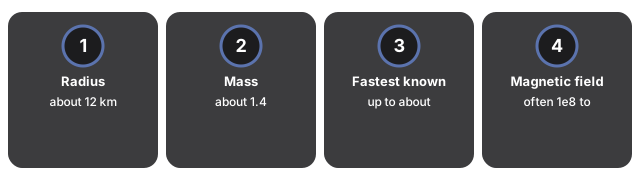
Radius about 12 km (order 10-12). Mass about 1.4 solar masses. Magnetic fields often 1e8 to 1e15 G. This lighthouse teaching view is not Black Hole 3D Explorer - a hard surface and beamed poles instead of an event horizon.
Neutron Star Pulsar 3D Explorer
FreetoolOnline editorial teamA pulsar reads like a lighthouse because its magnetic axis sits tilted about 55 deg away from the spin axis, so every turn sweeps a beam past Earth.
Drag to orbit the view, scroll or pinch to zoom, and press Play spin. Slow / Fast change the demo rate; Star and Beam fill the facts panel with the figures tabled below.
- Dense remnant sphere with equatorial glow
- Tilted magnetic axis (~55 deg) with dual lighthouse beams
- Play / Pause spin plus Slow / Fast demo rate controls
- Panel literacy for radius, mass, spin, and magnetic-field order
- Distinct from black-hole: hard surface + beaming, not an event horizon
- Runs fully in the browser with the vendored three.js engine - no account, no upload
Teachers use it to show why pulsars pulse, students scrub spin rate while reading 12 km / 1.4 Msun, and curious readers compare this compact remnant to Black Hole 3D Explorer.
| Quantity | Value | Source |
|---|---|---|
| Radius | about 12 km (order 10-12) | Standard neutron-star summaries |
| Mass | about 1.4 solar masses | Typical observed range center |
| Fastest known spins | up to about 716 Hz | Millisecond pulsar records |
| Magnetic field | often 1e8 to 1e15 G | Order-of-magnitude magnetosphere range |
Everything renders on your device with WebGL. The 3D engine loads once (about 0.7 MB) and is cached; no scene data is sent to a server.
The scene is an educational visualization - beams are teaching cones tilted about 55 deg, not a GRMHD plasma model or a pulsar timing catalog. For session fit, the three-step walkthrough, and a comparison against installed apps, read the Neutron Star Pulsar 3D Explorer guide.
The Space 3D collection also includes a Black Hole 3D Explorer for horizons and a Star Lifecycle 3D Explorer for how massive stars end.
Frequently Asked Questions
What does Neutron Star Pulsar 3D Explorer show?
A spinning neutron star with a tilted magnetic axis and dual lighthouse beams, plus a facts table for radius about 12 km, mass about 1.4 Msun, and spins up to about 716 Hz.
How is a pulsar different from a black hole?
A neutron star has a hard surface and can beam from magnetic poles. Black Hole 3D Explorer focuses on an event horizon - a different compact-object story.
Why do we see pulses?
When a magnetic beam sweeps across Earth, radio (and sometimes other bands) brighten briefly - the lighthouse effect behind the word pulsar.
Is the demo spin as fast as real millisecond pulsars?
No. The scene uses a slowed demo rate so beams stay readable. Real records reach about 716 Hz - the panel states that ceiling.
Is this a plasma or GRMHD simulation?
No. Beams are educational cones on a teaching geometry. It does not integrate magnetohydrodynamics or publish timing solutions.
How big is a neutron star?
About 10-12 km across - here about 12 km - with a mass near 1.4 solar masses packed into city-scale radius.