
Drag the throat-radius slider to rescale the exact catenoid embedding of a wormhole throat, watch the illustrative traversal marker cross from mouth A to mouth B, and read the cited 1916-1988 fact chain in the panel.
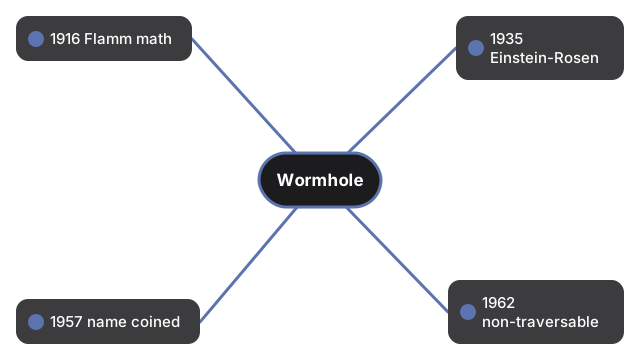
Published fact chain: Flamm 1916 first math solution; Einstein and Rosen 1935 bridge; Misner and Wheeler 1957 coin "wormhole"; Wheeler and Fuller 1962 show the Schwarzschild case pinches shut (not traversable); Morris and Thorne 1988 show a traversable version needs exotic matter never observed.
Drag to orbit and scroll or pinch to zoom. Move the throat-radius slider, or toggle the traversal marker.
Related general-relativity explorers: Black Hole 3D Explorer, Spacetime Curvature 3D Explorer, and Light Cone 3D Explorer. Walk the step-by-step guide.
Wormhole (Einstein-Rosen Bridge) 3D Explorer
A wormhole throat with zero tidal force has an exact embedding shape: a catenoid, r(l) = b0*cosh(l/b0), where b0 is the throat radius and l is the proper radial distance measured out from the throat. Ludwig Flamm found the first version of this math in 1916 as a companion to Karl Schwarzschild's own solution. Albert Einstein and Nathan Rosen published the Einstein-Rosen bridge in 1935. Charles Misner and John Wheeler coined the word "wormhole" in 1957.
Two later results matter for what this page can honestly claim. In 1962, Robert Fuller and John Wheeler showed that a Schwarzschild wormhole pinches shut before even a beam of light can cross it - so that version is not traversable. In 1988, Michael Morris and Kip Thorne showed that holding a throat open for real travel needs exotic matter that violates the null energy condition, and no such matter has ever been observed. This explorer renders the catenoid geometry and states both results; it never claims a wormhole exists or that travel through one is possible.
- Exact catenoid throat mesh built live from r(l) = b0*cosh(l/b0)
- Throat-radius slider (b0) rescales the whole geometry in real time
- Two flared mouths marked in orange and cyan
- Illustrative traversal marker with an on/off toggle and a speed slider
- Runs fully in the browser with the vendored three.js engine - no account, no upload
Anyone curious why science writers say "wormholes are allowed by the math but never seen" gets a concrete picture of the throat shape and the two results that explain the caveat.
| Year | Milestone | Source note |
|---|---|---|
| 1916 | Ludwig Flamm's first math solution | Schwarzschild-companion solution |
| 1935 | Einstein-Rosen bridge | Einstein and Rosen paper |
| 1957 | Term "wormhole" coined | Misner and Wheeler paper |
| 1962 | Schwarzschild wormhole shown non-traversable | Wheeler and Fuller |
| 1988 | Traversable version needs exotic matter | Morris and Thorne |
Everything renders on your device with WebGL. The 3D engine loads once (about 0.7 MB) and is cached; no scene data is sent to a server.
This is an educational embedding diagram, not a solver for the full Einstein field equations and not a model of exotic-matter physics. The traversal marker is illustrative only - it does not represent a real crossing, since the non-traversable Schwarzschild case pinches shut first.
For a step-by-step walkthrough, read the Wormhole 3D Explorer step-by-step guide. The Space 3D collection also includes Black Hole 3D Explorer and Spacetime Curvature 3D Explorer for related general-relativity context.
Frequently Asked Questions
Is this a real wormhole simulation?
No. It is an educational embedding diagram of the exact catenoid shape general relativity permits for a zero-tidal-force throat. It does not solve the full Einstein field equations and does not model exotic matter.
Have wormholes ever been observed?
No. No wormhole has ever been observed. The geometry is a solution the math of general relativity allows, first found by Ludwig Flamm in 1916.
Can anything actually travel through one?
Not the version shown by default. Wheeler and Fuller showed in 1962 that a Schwarzschild wormhole pinches shut before even light can cross. Morris and Thorne showed in 1988 that a traversable version would need exotic matter that has never been observed.
What does the throat-radius slider do?
It changes b0 in the formula r(l) = b0*cosh(l/b0), rescaling the entire catenoid mesh live so you can see the throat widen or narrow relative to the two flared mouths.
What is the traversal marker?
A small illustrative marker that animates from mouth A to mouth B along the throat surface. It is a visual aid only, not a claim that crossing is physically possible.
Who coined the word "wormhole"?
Charles Misner and John Wheeler, in a 1957 paper.