
The asteroid belt has gaps. Where an asteroid orbit would beat in simple step with Jupiter, the planet repeated gravitational tugs clear the zone - the Kirkwood gaps. This explorer draws the belt orbiting the Sun with dark rings swept out at the 3:1, 5:2 and 2:1 resonances.
Published literacy: the main gaps sit at the 3:1 (2.50 AU), 5:2 (2.82 AU), 7:3 (2.95 AU) and 2:1 (3.28 AU) resonances with Jupiter; Daniel Kirkwood found and explained them in 1866. They are dips in the distribution of orbital size, not empty space in a snapshot.
Drag to orbit and scroll or pinch to zoom. Pause the belt or hide the resonance markers.
Kirkwood Gaps 3D Explorer
Between Mars and Jupiter lies the asteroid belt - and it is carved by invisible grooves. Plot the asteroids by the size of their orbit and clear gaps appear at very specific distances. These are the Kirkwood gaps, and they mark where an asteroid orbit would fall into a simple rhythm with Jupiter. This explorer draws the belt orbiting the Sun, with the resonance zones swept dark.
The cause is orbital resonance. An asteroid at 2.50 AU would circle the Sun exactly three times for each Jupiter orbit - a 3:1 resonance - so Jupiter tugs it from the same direction over and over, pumping up its eccentricity until it is flung onto a new path. The same happens at the 5:2 gap (2.82 AU), the 7:3 gap (2.95 AU), and the 2:1 gap (3.28 AU, called the Hecuba gap). Daniel Kirkwood spotted the pattern in 1866 and correctly explained it. Not every resonance clears a gap - the 3:2 resonance holds the Hilda asteroids, and the 1:1 resonance holds the Trojans.
- The asteroid belt orbiting the Sun between Mars and Jupiter
- Dark gaps swept clear at the 3:1, 5:2, 7:3 and 2:1 resonances
- Blue rings marking the resonance distances (toggle on and off)
- Inner, middle, and outer belt zones in different tints
- Facts panel with the resonance distances and Kirkwood 1866
- Runs fully in the browser with the vendored three.js engine - no account, no upload
Students see that gravity sculpts the belt; teachers connect the integer ratios to the gap positions; curious readers learn that these gaps feed many of the near-Earth asteroids.
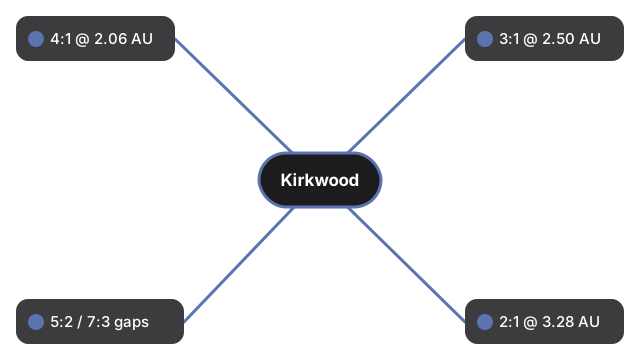
| Resonance | Distance | Note |
|---|---|---|
| 4:1 | 2.06 AU | Inner edge |
| 3:1 | 2.50 AU | Splits inner and middle belt |
| 5:2 / 7:3 | 2.82 / 2.95 AU | Middle belt |
| 2:1 | 3.28 AU | Hecuba gap, outer edge |
Everything renders on your device with WebGL. The 3D engine loads once (about 0.7 MB) and is cached; no scene data is sent to a server.
This is an educational visualization - the gaps are dips in the distribution of orbital size (semi-major axis). Here the asteroids ride idealized near-circular orbits so the gaps read as rings; a real snapshot, with eccentric orbits, partly fills them. Distances are not to scale.
For a step-by-step walkthrough, read the Kirkwood Gaps 3D Explorer step-by-step guide. The Space 3D collection also includes Asteroid Belt 3D and Jupiter Trojan Asteroids 3D.
Frequently Asked Questions
What are the Kirkwood gaps?
They are gaps in the distribution of asteroid orbit sizes in the main belt, at distances where an asteroid orbit would resonate with Jupiter. Daniel Kirkwood found them in 1866.
Where are the main gaps?
At the 3:1 resonance (2.50 AU), the 5:2 (2.82 AU), the 7:3 (2.95 AU) and the 2:1 (3.28 AU, the Hecuba gap). A weaker one sits at the 4:1 resonance near 2.06 AU.
How does a resonance clear a gap?
An asteroid whose period is a simple fraction of Jupiter meets the planet at the same point over and over. The repeated tugs build up its eccentricity until its orbit changes and it leaves the zone.
Do all resonances make gaps?
No. Some trap asteroids instead. The 3:2 resonance holds the Hilda asteroids, and the 1:1 resonance holds Jupiter Trojans. Whether a resonance clears or traps depends on its dynamics.
Would I see these gaps in a photo of the belt?
Not clearly. The gaps are in the distribution of orbital sizes; because real orbits are eccentric, asteroids drift across the gap distances at times. The depletion is sharpest in a histogram of semi-major axis.
Is this scene to scale?
No. Distances and sizes are compressed for clarity, and the asteroids are drawn on idealized near-circular orbits so the gaps read as rings. It is meant to show where the gaps fall, not exact positions.