
Triton is Neptune's largest moon - about 2,700 kilometers across - and its western hemisphere wears a unique melon-skin landscape called cantaloupe terrain. Press play to spin the moon, face the dimpled hemisphere, and toggle the schematic cavi grid.
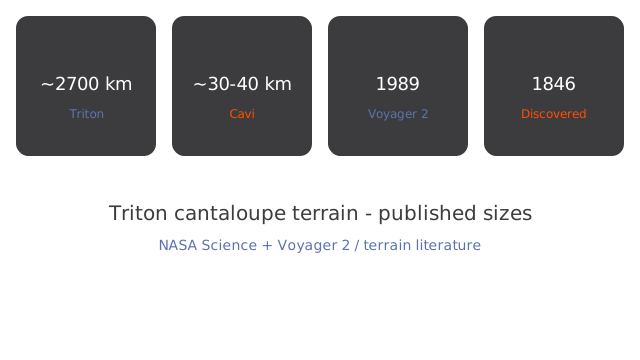
Published figures: Triton ~2,700 km across; cantaloupe cavi ~30-40 km; Voyager 2 flyby 25 Aug 1989; moon discovered 1846.
Drag to orbit and scroll or pinch to zoom. Press Play or toggle Dimples.
Related explorers: Hyperion Sponge Moon 3D Explorer and Mimas Herschel Crater 3D Explorer. Walk the step-by-step guide.
Triton Cantaloupe Terrain 3D Explorer
Triton is the largest moon of Neptune - about 2,700 kilometers across in NASA summaries, with Voyager 2 refining the diameter near 2,706 kilometers. It is the only large Solar System moon on a retrograde orbit. Voyager 2 flew past on 25 August 1989 and returned the first close views of cantaloupe terrain.
That landscape fills much of Triton's western hemisphere: closely spaced dimples (cavi) about 30 to 40 kilometers across, with crosscutting ridges. Leading ideas include diapirism or stresses from global cooling. This explorer shows a schematic dimple grid without picking one origin story, and it does not model nitrogen geysers.
- Smooth Triton sphere with schematic cantaloupe cavi
- Toggleable dimple grid plus a simple sulci ridge X
- Neptune in the background for orbital context (not to scale)
- Speed slider and Play/Pause
- Runs fully in the browser with the vendored three.js engine - no account, no upload
| Figure | Value | Source note |
|---|---|---|
| Triton diameter | ~2,700 km / ~2,706 km | NASA Science; Voyager refinement |
| Cavi width | ~30-40 km | Terrain literature / Voyager summaries |
| Orbit sense | Retrograde | NASA |
| Voyager 2 flyby | 25 Aug 1989 | NASA |
| Discovered | 1846 | William Lassell |
Everything renders on your device with WebGL. Dimple size and spacing are exaggerated for readability - not a Voyager DEM.
For a step-by-step walkthrough, read the Triton Cantaloupe Terrain 3D Explorer step-by-step guide. The Space 3D collection also includes Hyperion Sponge Moon 3D Explorer and Mimas Herschel Crater 3D Explorer.
Frequently Asked Questions
What is cantaloupe terrain?
A Triton-only landscape of closely spaced, melon-like dimples (cavi) about 30-40 kilometers across, mapped by Voyager 2 in 1989 on the western hemisphere.
How did the dimples form?
Leading ideas include diapirism and global cooling contraction. Evidence is debated. This page shows geometry, not a formation verdict.
What do Play, Dimples, and Speed do?
Play starts or pauses spin. Dimples shows or hides the schematic cavi grid. Speed changes how fast the animation runs.
Is this a Voyager terrain model?
No. It is a procedural schematic grounded in published sizes. Dimples are exaggerated for visibility.
Does this show Triton's geysers?
No. Voyager saw nitrogen geysers elsewhere on Triton; this explorer focuses on cantaloupe terrain only.