
People say the Moon orbits Earth, but really both bodies swing around their shared centre of mass - the barycenter. Because Earth outweighs the Moon about 81 to 1, that point is not between them out in space; it sits inside Earth, about 4,671 km from the centre (73% of the way to the surface). So Earth wobbles in a small monthly circle while the Moon loops around the far side. Press play and watch Earth swing around the yellow dot.
Published literacy: the Earth-Moon barycenter lies about 4,671 km from Earth centre - roughly 73% of the planet radius (6,371 km), so about 1,700 km below the surface. The Moon averages 384,400 km away, and Earth is about 81 times more massive, which is why the common point falls inside our planet rather than in open space.
Drag to orbit and scroll or pinch to zoom. Change the speed, hide the wobble trail, or pause the motion.
Earth-Moon Barycenter 3D Explorer
It is natural to picture the Moon circling a fixed Earth, but gravity is a two-way street. Earth and the Moon both orbit their shared centre of mass, a point called the barycenter. Since Earth is about 81 times heavier than the Moon, that balance point is pulled far toward Earth - in fact inside it, roughly 4,671 km from the centre, about 73% of the way out to the surface. This explorer puts that point at the middle of the view and lets you watch Earth swing around it in a small monthly circle while the Moon sweeps the wide loop on the opposite side.
That inner balance point has real consequences. Earth does not travel a perfectly smooth path around the Sun; its centre veers slightly inside and outside the true orbital line every month as it swings around the barycenter, which itself is what actually follows the smooth solar orbit. The same idea, scaled up, is how astronomers detect planets around other stars: a heavy planet makes its star wobble around their shared barycenter, and that tiny wobble shows up in the star light. For the Earth and Moon the point stays buried in the mantle today, though across billions of years the slowly receding Moon will eventually carry it out past the surface.
- The barycenter fixed at the centre, drawn as a bright dot inside a see-through Earth
- Earth wobbling in a small circle while the Moon loops the far side, always opposite
- A lever line joining Earth centre, the barycenter, and the Moon to show the balance
- A traced wobble path for Earth centre and a toggle to hide it
- A speed slider and pause, with the real 4,671 km and 81 to 1 figures in the panel
- Runs fully in the browser with the vendored three.js engine - no account, no upload
Students correct the "Moon goes around Earth" picture; teachers link the wobble to how exoplanets are found; the curious see where the balance point actually hides.
| Figure | Value | Source note |
|---|---|---|
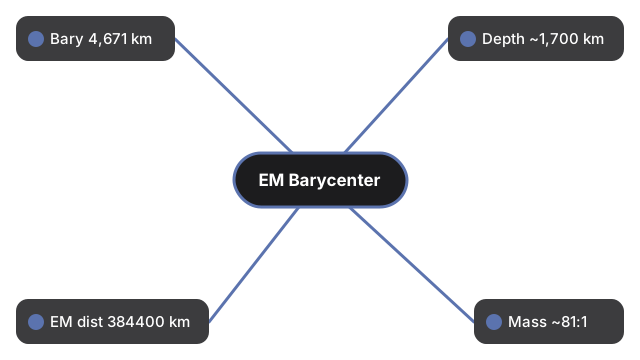
| Barycenter from Earth centre | 4,671 km | 73.3% of Earth radius |
| Depth below surface | about 1,700 km | 6,371 - 4,671 km |
| Earth-Moon distance | 384,400 km | Mean, about 60 Earth radii |
| Mass ratio Earth to Moon | about 81 : 1 | Moon 0.0123 Earth masses |
Everything renders on your device with WebGL. The 3D engine loads once (about 0.7 MB) and is cached; no scene data is sent to a server.
This is an educational visualization - the barycenter-inside-Earth ratio (73% of the radius) is drawn true, but the Moon distance and size are compressed so both fit the frame, and the motion is sped up; it is not to scale for the Moon.
For a step-by-step walkthrough, read the Earth-Moon Barycenter 3D Explorer step-by-step guide. The Space 3D collection also includes Tides: Earth and Moon 3D and Synodic Lunar Month 3D.
Frequently Asked Questions
What is the barycenter?
It is the shared centre of mass of two bodies. Instead of one orbiting the other, both swing around this balance point. For the Earth and Moon it sits inside Earth.
How far is it from Earth centre?
About 4,671 km, which is roughly 73% of Earth mean radius of 6,371 km. That places it about 1,700 km below the surface, inside the mantle.
Why is it inside Earth?
Earth is about 81 times more massive than the Moon, so the balance point is pulled strongly toward Earth. It only leaves a body when the two masses are closer or spread far apart, as with Pluto and Charon.
Does Earth really wobble?
Yes. Earth centre traces a small monthly circle around the barycenter, so it veers slightly inside and outside its smooth path around the Sun each month.
What does this have to do with exoplanets?
The same physics scaled up: a planet makes its star wobble around their shared barycenter, and measuring that tiny stellar wobble is one way astronomers find planets around other stars.
Is this scene to scale?
The barycenter-inside-Earth ratio (73% of the radius) is drawn true, but the Moon distance and size are compressed so both fit, and the motion is sped up. It is not to scale for the Moon.