Time in milliseconds: the unit, the conversions, and where it shows up
A time in milliseconds is a plain number where one second equals 1000 milliseconds (ms). The value carries two meanings: a duration, like a 300 ms animation, or a moment in time, like a 13-digit epoch timestamp. Knowing which one you are reading is the difference between a correct result and a date off by decades.
Last reviewed: 2026-07-03
FreetoolOnline editorial teamTwo meanings: a duration or a moment
The same phrase points at two different quantities. A duration is how long something lasts: a 250 ms timeout, a 16.7 ms animation frame, a 200 ms network round trip. It is a length with no start date attached. A moment is a single point on the clock, written as the count of milliseconds since a fixed origin - the Unix epoch at 1970-01-01T00:00:00 UTC. Today that count is a 13-digit integer. Reading a duration as if it were a moment, or the reverse, is the most common mistake with millisecond values.
If you want the current moment in milliseconds, the value is a live epoch integer: open the time in milliseconds tool to copy it, and see current time in milliseconds for how to use it in a log line or an API call. If you already have a moment and want a readable date, paste it into milliseconds to date or read convert milliseconds to date.
Convert common durations to milliseconds
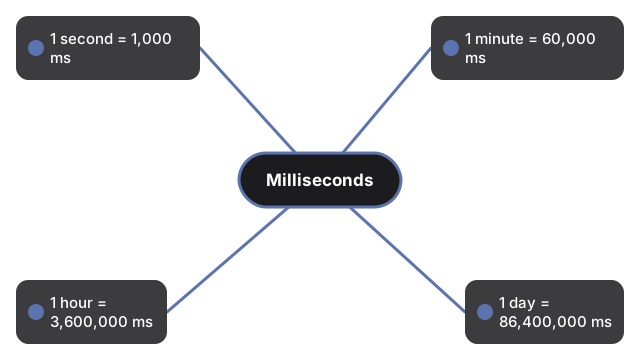
Every duration in milliseconds is the number of seconds multiplied by 1000. The values below are the ones you reach for most often when setting a timer, a cache lifetime, or an animation.
| Duration | In milliseconds |
|---|---|
| 1 second | 1000 ms |
| 1 minute | 60000 ms |
| 1 hour | 3600000 ms |
| 1 day | 86400000 ms |
| 1 week | 604800000 ms |
| 1 frame at 60 fps | about 16.67 ms |
| 1 frame at 30 fps | about 33.33 ms |
Where time in ms shows up in code
Where time in ms shows up in code: setTimeout delays, animation frames, Date.now() timestamps, and many APIs that store Unix epoch milliseconds - use Time in Milliseconds when you need the live epoch integer or a duration conversion without leaving the browser.
Convert a duration to or from milliseconds
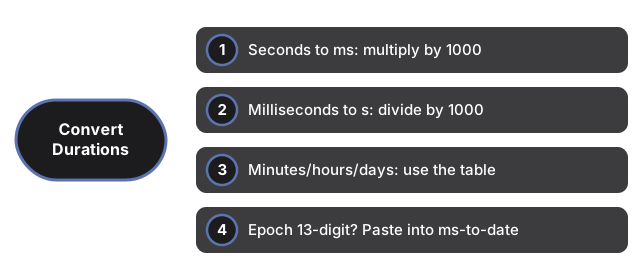
- Seconds to milliseconds: multiply by 1000. So 2.5 seconds is 2500 ms.
- Milliseconds to seconds: divide by 1000. So 250 ms is 0.25 seconds.
- Minutes, hours, and days: use the table above, or multiply the seconds count by 1000. So 5 minutes is 300 seconds, which is 300000 ms.
- For a moment rather than a duration, a 13-digit epoch value, paste it into milliseconds to date to see the calendar date, and check milliseconds to date: UTC vs local time for the timezone display.
Frequently asked questions
How many milliseconds are in a second?
There are 1000 milliseconds in one second. From there, one minute is 60000 ms, one hour is 3600000 ms, and one day is 86400000 ms. Every duration in milliseconds is the number of seconds multiplied by 1000.
Is a time in ms the same as a Unix timestamp?
Only when the value is a moment. A duration such as 300 ms is a length and has no date attached. A Unix timestamp in milliseconds is a moment: the count of milliseconds since 1970-01-01T00:00:00 UTC, which today is a 13-digit integer. For that meaning, see current time in milliseconds.
Why do timers and animations use milliseconds?
Sub-second timing is common, and milliseconds give enough resolution without decimals. A 250 ms delay is finer than a 1 second delay, and setTimeout, setInterval, and CSS animation durations all accept millisecond values directly.
What is the difference between a 10-digit and a 13-digit value?
A moment in seconds is a 10-digit number; the same moment in milliseconds is that number times 1000, which is 13 digits. Feeding a 13-digit millisecond value into a parser that expects seconds produces a date far in the future, around the year 58000. Check the digit count before converting.
How do I get the current time in ms right now?
Call Date.now() in JavaScript, or open the time in milliseconds tool to read and copy the live epoch value without any install. The number changes on every read because it tracks the live clock.
Related: for the live current millisecond value, see current millis. For a long integer that could be either seconds or milliseconds, see long number - millisecond or second.
Why trust these tools
- Ten-plus years of web tooling. The freetoolonline editorial team has shipped browser-based utilities since 2015. The goal has never changed: get you to a working output fast, without an install.
- No install, no sign-up. Open a tool and get a working output in seconds - nothing to download and no account to create. Tools that need heavy processing run it on our service, so even a low-powered machine gets the job done.
- Analytics stops at the page view. We measure which pages get visited, not what you type or upload inside a tool. There is nothing to sign in to and no profile is attached to your input.
- Open-source core components. The processing engines underneath (libheif, libde265, pdf-lib, terser, clean-css, ffmpeg.wasm, and others) are public and audit-able. We link to each one in its tool page's footer.
- Free, with or without ads. All tools are fully functional without sign-up. The Disable Ads button in the header is always available if you need a distraction-free run.