Compsognathus Size Comparison
Compsognathus 3D Viewer pairs published figures for a small Late Jurassic European theropod with a 1.8 m person - length panel baseline 1.25 m and mass panel baseline 3 kg - with German and French specimen ranges disclosed separately.
Compsognathus published figures
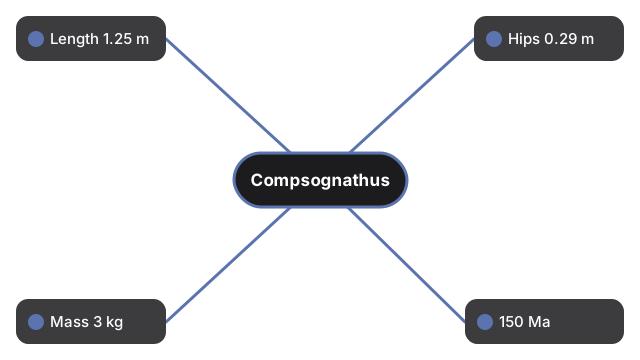
The Compsognathus facts panel and this table use the same real published measures (German and French specimen ranges disclosed separately):
| Measure | Figure | Vs a 1.8 m person |
|---|---|---|
| Length | about 0.7-1.4 m across specimens (German about 0.7-0.9 m; French adult about 1.25-1.4 m; panel baseline 1.25 m); Size vs human uses 1.25 m | shorter than a 1.8 m person end-to-end at the 1.25 m scale figure (~0.7x a person) |
| Hip height | about 0.20-0.29 m (panel baseline 0.29 m) | ~0.16x adult standing height - roughly knee height on a person |
| Weight | about 0.3-3.5 kg across specimens (German about 0.3-0.6 kg; French about 2.5-3.5 kg; panel baseline 3 kg) | far lighter than a human body mass at the panel baseline |
| When it lived | about 150 million years ago | Late Jurassic (Tithonian); Solnhofen (Germany) and Canjuers (France) |
| Specimen ranges (disclosed) | Small Late Jurassic European theropod; carnivore (small vertebrates); Wagner 1859 | German and French specimen ranges kept separate from panel headline figures |
How the Compsognathus size-vs-human toggle stays honest
The Compsognathus model is drawn to a fixed on-screen length so it fits the canvas; the Size vs human control then places a 1.8 m person at the true length ratio to the catalogue 1.25 m panel baseline. Tap Size vs human under the canvas to show or hide the scale figure - the comparison is proportional, not a decorative sticker.
What a person would see beside a Compsognathus
What a person would see is a chicken-sized theropod whose panel length is 1.25 m - shorter than a 1.8 m person end-to-end - with hip height about 0.29 m in the panel silhouette. Turn on Size vs human and orbit beside a hind leg to feel how a small Late Jurassic predator compares to you.
What the Compsognathus size numbers are not
What these size numbers are not is a blended composite: the panel headline figures (1.25 m / 0.29 m hip / 3 kg) are never merged with the German juvenile range (about 0.7-0.9 m / 0.3-0.6 kg) or treated as if every specimen matched the French adult. Soft-tissue color in the viewer is still an artistic reconstruction. This model is not a fossil-accurate skeleton. For the control walkthrough see how to view Compsognathus in 3D. For trade-offs versus phone AR apps see Compsognathus 3D viewer vs AR apps.
Why trust these tools
- Ten-plus years of web tooling. The freetoolonline editorial team has shipped browser-based utilities since 2015. The goal has never changed: get you to a working output fast, without an install.
- No install, no sign-up. Open a tool and get a working output in seconds - nothing to download and no account to create. Tools that need heavy processing run it on our service, so even a low-powered machine gets the job done.
- Analytics stops at the page view. We measure which pages get visited, not what you type or upload inside a tool. There is nothing to sign in to and no profile is attached to your input.
- Open-source core components. The processing engines underneath (libheif, libde265, pdf-lib, terser, clean-css, ffmpeg.wasm, and others) are public and audit-able. We link to each one in its tool page's footer.
- Free, with or without ads. All tools are fully functional without sign-up. The Disable Ads button in the header is always available if you need a distraction-free run.