When to Use the JWST Deployment Sequence 3D Explorer
Open the JWST Deployment Sequence 3D Explorer when you want a fast, real-dates answer to why the James Webb Space Telescope had to fold up for launch, and exactly how its tower, sunshield, and mirror unfolded once in space.
Sessions this explorer fits
Students and teachers explaining why a 6.5 m mirror and a 21x14 m sunshield could not fit inside a rocket fairing already assembled, readers who remember the January 2022 deployment news and want the real order of events, and anyone curious how a spacecraft can have 178 release mechanisms that all had to work all get a direct answer here.
When the JWST deployment-sequence explorer is the wrong pick
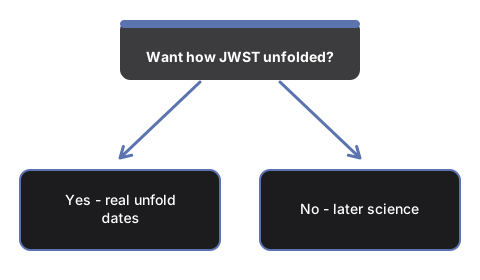
This explorer stops the moment the roughly two-week unfolding is finished, so it is the wrong choice if you want what the James Webb Space Telescope did once the sequence ended - the months-long cool-down, the fine alignment of its 18 gold mirror segments, and the first science images. That post-deployment chapter belongs to the JWST L2 Halo Orbit 3D Explorer, which begins only after the fully opened telescope reaches its orbit around the second Sun-Earth Lagrange point about 1.5 million km from Earth. Here the timeline runs the other way: from the folded launch configuration on 25 December 2021 through the forward and aft pallet lowering, the mid-boom sunshield extension, the layer-by-layer sunshield tensioning, the secondary-mirror tripod deployment, and the final side-wing latch that opened the 6.5 m primary mirror in early January 2022. If your question is why a 6.5 m mirror and a 21x14 m sunshield could not launch already assembled, or in what order the 178 release mechanisms fired, this is the right explorer - it answers the folding-and-unfolding story with real dates rather than the science that follows. To walk those stages one control at a time and see the real day each release fired, open the step-by-step guide.
Why trust these tools
- Ten-plus years of web tooling. The freetoolonline editorial team has shipped browser-based utilities since 2015. The goal has never changed: get you to a working output fast, without an install.
- No install, no sign-up. Open a tool and get a working output in seconds - nothing to download and no account to create. Tools that need heavy processing run it on our service, so even a low-powered machine gets the job done.
- Analytics stops at the page view. We measure which pages get visited, not what you type or upload inside a tool. There is nothing to sign in to and no profile is attached to your input.
- Open-source core components. The processing engines underneath (libheif, libde265, pdf-lib, terser, clean-css, ffmpeg.wasm, and others) are public and audit-able. We link to each one in its tool page's footer.
- Free, with or without ads. All tools are fully functional without sign-up. The Disable Ads button in the header is always available if you need a distraction-free run.