Initializing, please wait a moment
How to explore Apollo Landing Sites on the Moon 3D Explorer
Open the explorer and click each yellow marker to see where the six Apollo crews actually landed.
- Open https://freetoolonline.com/space-3d/apollo-landing-sites-moon-3d.html and wait for the Moon and six yellow markers to appear.
- Click any marker on the Moon - the facts panel fills with that mission's landing date and crew.
- Use the dropdown above the scene to jump straight to any of the other five missions.
- Drag to rotate the Moon and compare how far apart the six sites really are.
- Read the site names table below for a quick side-by-side of all six landings.
Apollo landing key figures
| Figure | Value |
|---|---|
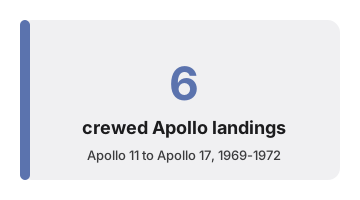
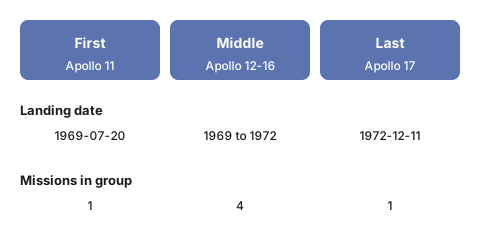
| Crewed landing sites plotted | 6 (Apollo 11, 12, 14, 15, 16, 17) |
| First landing | Apollo 11, 1969-07-20 |
| Last landing | Apollo 17, 1972-12-11 |
Next: the when guide or vs alternatives. Open the Apollo Landing Sites on the Moon 3D Explorer.
Why trust these tools
- Ten-plus years of web tooling. The freetoolonline editorial team has shipped browser-based utilities since 2015. The goal has never changed: get you to a working output fast, without an install.
- No install, no sign-up. Open a tool and get a working output in seconds - nothing to download and no account to create. Tools that need heavy processing run it on our service, so even a low-powered machine gets the job done.
- Analytics stops at the page view. We measure which pages get visited, not what you type or upload inside a tool. There is nothing to sign in to and no profile is attached to your input.
- Open-source core components. The processing engines underneath (libheif, libde265, pdf-lib, terser, clean-css, ffmpeg.wasm, and others) are public and audit-able. We link to each one in its tool page's footer.
- Free, with or without ads. All tools are fully functional without sign-up. The Disable Ads button in the header is always available if you need a distraction-free run.