Local Bubble Interstellar Cavity 3D Explorer vs Galactic Year - Sun's Orbit 3D Explorer
freetoolonline.com editorial teamBoth pages scrub a real story about the Sun's place in the galaxy in one page load - 0 MB installed, USD 0, no account. The Local Bubble Interstellar Cavity 3D Explorer covers the Sun's immediate neighborhood, a roughly 1,000-light-year-wide cavity carved out by past supernovae; the Galactic Year - Sun's Orbit 3D Explorer covers the Sun's much larger, ongoing orbit around the Milky Way's center, roughly 26,000-28,000 light-years away.
The numbers side by side
| Aspect | Local Bubble Explorer | Galactic Year Explorer |
|---|---|---|
| Install size | 0 MB - runs in the browser | 0 MB - runs in the browser |
| Price | USD 0 | USD 0 |
| Scale | About 1,000 light-years across | About 26,000-28,000 light-years to the galactic center |
| Timescale shown | About 14 million years (the bubble's formation history) | About 230 million years (one galactic year) |
| What it teaches | How a chain of supernovae carved out the Sun's immediate cavity, and which regions sit on its edge | How the Sun orbits the Milky Way's center and bobs through the galactic disk |
| Key published figures | About 15 supernovae; Sun entered about 5 million years ago; 7 named surface regions | About 220-230 km/s orbital speed; about 20 orbits since the Sun formed |
| Does it repeat? | No - a one-time formation history, still slowly expanding | Yes - the Sun has completed about 20 such orbits since it formed |
Where the Galactic Year Explorer wins
The Galactic Year Explorer wins when the question is how the Sun moves around the whole Milky Way - it is the only page on the site modeling the Sun's galaxy-wide orbital path and its up-and-down drift through the disk.
Where the Local Bubble Explorer wins
The Local Bubble Explorer wins when the question is what surrounds the Sun right now, close up - it is the only page on the site showing the actual cavity in the interstellar medium the Sun currently sits inside, and which real star-forming regions ring its edge.
A reasonable rule
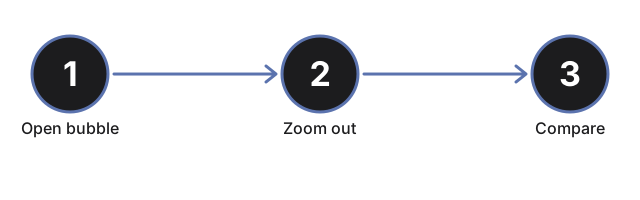
As a reasonable rule, use the Local Bubble Explorer first to see the Sun's immediate ~1,000-light-year surroundings, then use the Galactic Year Explorer to zoom out to the Sun's ~26,000-light-year journey around the whole galaxy.
See how to use the Local Bubble Interstellar Cavity 3D Explorer for a step-by-step walkthrough.
Why trust these tools
- Ten-plus years of web tooling. The freetoolonline editorial team has shipped browser-based utilities since 2015. The goal has never changed: get you to a working output fast, without an install.
- No install, no sign-up. Open a tool and get a working output in seconds - nothing to download and no account to create. Tools that need heavy processing run it on our service, so even a low-powered machine gets the job done.
- Analytics stops at the page view. We measure which pages get visited, not what you type or upload inside a tool. There is nothing to sign in to and no profile is attached to your input.
- Open-source core components. The processing engines underneath (libheif, libde265, pdf-lib, terser, clean-css, ffmpeg.wasm, and others) are public and audit-able. We link to each one in its tool page's footer.
- Free, with or without ads. All tools are fully functional without sign-up. The Disable Ads button in the header is always available if you need a distraction-free run.