How to Use the Local Bubble Interstellar Cavity 3D Explorer - Step by Step
Open the Local Bubble Interstellar Cavity 3D Explorer, press Play or drag the timeline slider, then click a marker or read the facts panel to see the real published figures behind the Sun's 1,000-light-year-wide neighborhood.
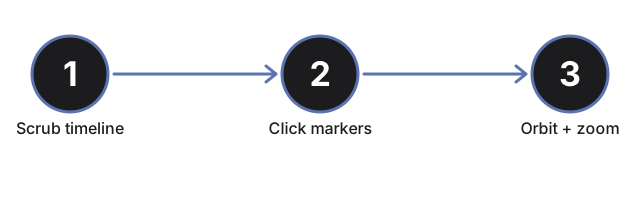
Press Play or drag the timeline slider
Press the Play button to auto-advance through the bubble's 14-million-year history, or drag the timeline slider (0 to 14 million years) to jump straight to any point. Dragging the slider pauses auto-play.
Watch the bubble grow and the Sun drift in
As the timeline advances, the translucent shell grows outward and the small yellow Sun marker drifts in from far outside toward the middle - the status line calls out the moment the Sun crosses into the bubble, about 5 million years ago on the real timeline.
Read the live supernova counter
The facts panel's live counter ticks up toward about 15 as the timeline advances, matching the published estimate for how many supernovae shaped the bubble.
Click the seven blue region markers
Click any of the seven blue markers on the bubble's surface to read that region's real published distance and role: Ophiuchus, Lupus, Pipe, Chamaeleon, Musca, Corona Australis, or the Taurus molecular cloud.
Show Perseus and Orion
Press "Show Perseus & Orion (not on this bubble)" to reveal two additional markers for two well-known nearby regions that are commonly assumed to sit on the Local Bubble's surface but, per the published research, actually are not - click either one to read why.
Drag to orbit and use fullscreen
Drag to orbit the camera, scroll or pinch to zoom, and use the Fullscreen button to expand the whole wrapper for a clearer view as the bubble grows.
Next: see when to use this explorer or how it compares to the Galactic Year - Sun's Orbit 3D Explorer.
Why trust these tools
- Ten-plus years of web tooling. The freetoolonline editorial team has shipped browser-based utilities since 2015. The goal has never changed: get you to a working output fast, without an install.
- No install, no sign-up. Open a tool and get a working output in seconds - nothing to download and no account to create. Tools that need heavy processing run it on our service, so even a low-powered machine gets the job done.
- Analytics stops at the page view. We measure which pages get visited, not what you type or upload inside a tool. There is nothing to sign in to and no profile is attached to your input.
- Open-source core components. The processing engines underneath (libheif, libde265, pdf-lib, terser, clean-css, ffmpeg.wasm, and others) are public and audit-able. We link to each one in its tool page's footer.
- Free, with or without ads. All tools are fully functional without sign-up. The Disable Ads button in the header is always available if you need a distraction-free run.